Hermeneutics for a time of rapid change · A work in progress, in common
Version 3 · November 1, 2026 · Work in progress
Technological and social change now arrives faster than our ways of knowing can settle it. Hermeneutics moves the question from how we know to how we understand, and the argument that runs from Gadamer through Habermas to Ricoeur locates the interface where understanding meets critique. This map is the Institute’s working position on that interface. It is drafted in the open, and it is meant to be read, questioned, and corrected together.
This is a draft of an argument, not a finished one. Every Gadamer, Habermas, and Ricoeur topic carries a note with the paraphrase, the printed pages, and the phrase checked against the text. The purple topics are the institute’s own claims. The yellow topics are open questions, and also the places where we doubt our own weaker areas. Several of them could cost the position its strongest claim. If you see a mistake, a missing text, or a better reading, write to info@dghumana.com.
Subject and object become standpoints
The heart of the position, in the map’s own sentences. Each card is a topic on the map; purple marks the Institute’s claims.
- DGHGoverning statement
Subject and object become meaningful, understandable, and distinguishable only within, by, and through relationship; the interface itself, the push and pull between them, is therefore where to look.
- MHow to read it
Read as a claim about standings, not existence: the bearers exist; “subject” and “object” name what each becomes inside an encounter.
- DGHBefore and within
The relata exist before the encounter; their standings as subject and object arise within it.
- DGHThree sides
Understanding is what the encounter yields; three sides shape it: us, what we meet, the meeting.
- DGHOnly as shared
Meaning-carrying relations exist only as shared: at least two participants who can correct each other’s use.
- DGHLanguage
Language is the fullest form that sharing and correcting encounters takes; it is not the origin of the relation.
- DGHThe interface
Understanding and critique are two movements inside one relation, belonging and distance; the relation is where change is received and where it is tested.
- DGHFor persons
Standings, not things, for the self: the who is assigned in address and imputation, in the second and third person as much as the first.
Quoted from the Relationship and Ricoeur stages of the map, version 3. The governing statement is from the Institute’s 10-20 paper, p. 1.
Why hermeneutics, and why now
The older question, how we can be certain of what we know, does not reach the situation we are in. Machines, records, and institutions now assign us our standing, as patient, applicant, user, or risk, faster than we can contest it. The question that reaches that situation is how understanding happens to us and how it can be corrected. Gadamer makes the move: understanding is an event we are drawn into, not a method we apply. Habermas presses the question the move leaves open: how can understanding be tested when the conditions of agreement are themselves distorted? Ricoeur shows that the two belong together. Interpretation has a critical moment inside it, and critique has an inheritance it cannot do without.
That interface, understanding met by critique, is where we think adjustment to rapid change has to be worked out, and it is why this map exists. Our own claim sits between the three: subject and object are standings assigned within the encounter, meaning-carrying relations exist only as shared, and language is the fullest form of the relation, not its origin. The map shows where that claim is kept, where it is corrected, and where it is still owed an argument.
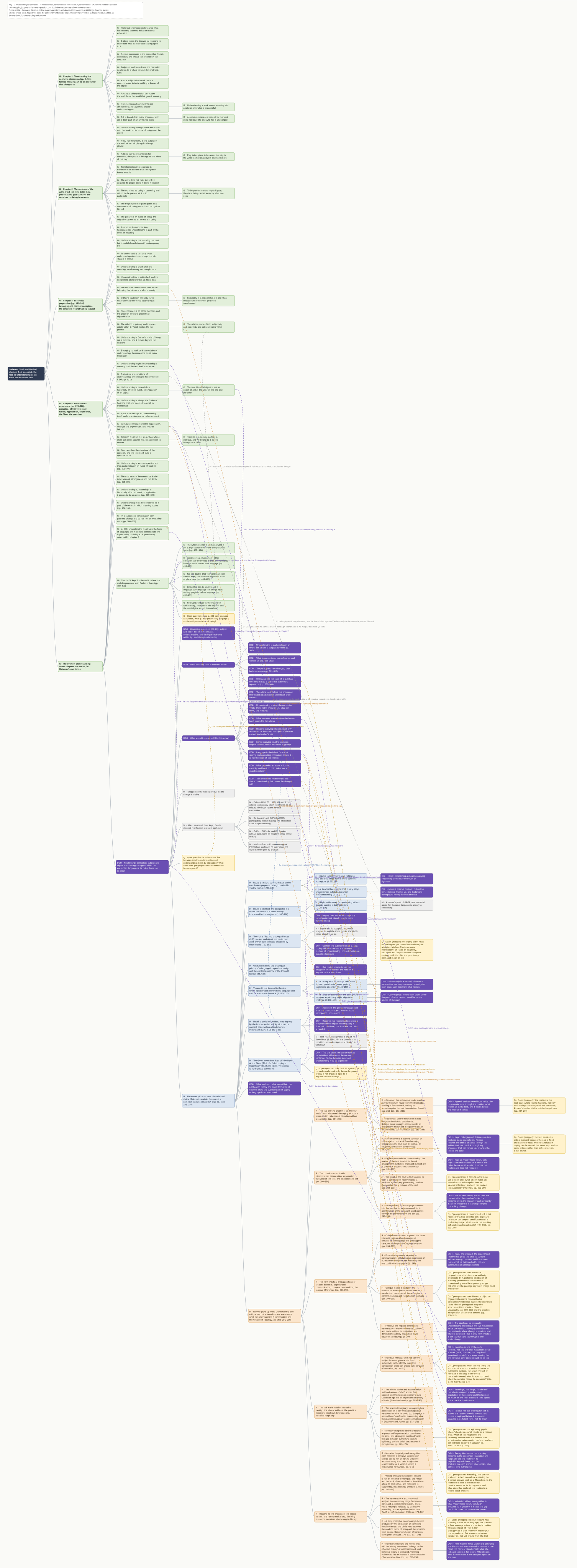
Key
- GGadamer, paraphrased, with printed page and the phrase checked against the PDF
- HHabermas, paraphrased: Theory of Communicative Action 1 and 2, Truth and Justification
- RRicoeur, paraphrased: Hermeneutics and the Critique of Ideology and seven companion essays
- DGHThe institute’s position: Relationship as standings assigned within the encounter, not things
- MMapping judgment: why a topic sits where it does, and what was dropped
- QOpen question, or a doubt we flag about a weaker area of our own position
- ⚑The hinge: p. 386, understanding must take the form of language
- Labeled cross-link carrying an inferential step across the tree
Reading path
The map read left to right, as six stages. Open any stage for its full outline with notes; “⌖ map” moves the map above to that topic. Each stage has its own conversation below.
Gadamer, chapters 1 to 4
Each chapter is a route of six to nine stations in the chapter’s own order.
Read the 48 topics of this stage
- Gadamer, Truth and Method, chapters 1–4, accepted: the road to understanding as an event we are drawn into
Note
Version 3, November 1, 2026, DG Humana working map. Read left to right. The four chapter branches are Gadamer's route to the event of understanding, accepted for this argument, language included. The fifth branch, The event of understanding, collects Gadamer's own statements of the event; its last children are the hinge of p. 386 (a promissory note, not an exit), the chapter 5 audit (where DGH's real disagreement with Gadamer lives), and DGH's branch, Relationship: subject and object are standings assigned within the encounter, and language is the fullest form of the relation, not its origin. Habermas is picked up inside that branch; the purple overlay is placed where his text needs or admits a pre-propositional relation. Ricoeur is picked up after Habermas, as the interface of understanding and critique; the overlay sits where his text states the relation from the reader's side, and the yellow topics carry the open questions and the mapper's doubts about the weaker areas. Version 2 (October 31) is kept beside this file as the record of the corrected position before Ricoeur was added.
- GChapter 1, Transcending the aesthetic dimension (pp. 3–105): formed knowing; art as an encounter that changes us
Note
G: Accepted for this argument. The chapter removes method and the sovereign aesthetic subject as the explanation of the truth art and the human sciences convey, and ends by asking for the mode of being of the encounter. G: Neither the natural sciences' method nor a subjective aesthetic faculty can account for the truth the human sciences and art convey. The humanist concepts of Bildung, sensus communis, judgment, and taste name a formed, situated knowing; aesthetic consciousness and Erlebnis are abstractions. The experience of art is finite, binding knowledge: an encounter that changes the one who understands.
- GHistorical knowledge understands what has uniquely become; induction cannot exhaust it
Note
G: The human sciences aim to understand how this person, people, or state became what it is, not to confirm laws for prediction. Helmholtz's tact, memory, and authority name what induction cannot explain. M: This opens the deficit the road to understanding as event will fill. Pages: pp. 3–8 (Bloomsbury 2013); Zotero PDF p. 42. Source: chapter Toulmin map, maps 1, 2. Check: phrase "understand the phenomenon itself in its unique and historical concreteness" verified against the PDF.
- GBildung forms the knower by returning to itself from what is other and staying open to it
Note
G: What is appropriated in Bildung is not a means but becomes one's own and keeps forming how one perceives. Its general characteristic is keeping oneself open to other, more universal viewpoints, a sense rather than a rule. This formed openness, not method, makes humanistic tact possible. Also here: Spirit's basic movement is to recognize its own in the alien and return from the other (pp. 13–14). Pages: pp. 8–17 (Bloomsbury 2013); Zotero PDF p. 55. Source: chapter Toulmin map, maps 3, 4, 5. Check: phrase "keeping oneself open to what is other" verified against the PDF.
- GSensus communis is the sense that founds community and knows the probable in the concrete
Note
G: Vico's sensus communis is not a faculty in everyone but the communal sense that gives the will its direction, nourished on the probable rather than the demonstrable, like Aristotle's phronesis. Oetinger adds that understanding a whole requires application to oneself, beyond any rule. Also here: Understanding a whole requires applying it to oneself, more than any hermeneutical rule (pp. 27–28). Pages: pp. 18–28 (Bloomsbury 2013); Zotero PDF p. 58. Source: chapter Toulmin map, maps 6, 7. Check: phrase "that general faculty in all men but the sense that founds" verified against the PDF.
- GJudgment and taste know the particular in relation to a whole without demonstrable rules
Note
G: Subsuming a case under a rule cannot itself be demonstrated; judgment is practiced case by case like a sense. Taste is a way of knowing that judges whether something fits a whole and claims that others should agree. Application supplements and develops the law productively. Pages: pp. 28–37 (Bloomsbury 2013); Zotero PDF p. 68. Source: chapter Toulmin map, maps 8, 9, 10. Check: phrase "cannot be taught in the abstract but only practiced from case to case" verified against the PDF.
- GKant's subjectivization of taste is epoch-making: in taste nothing is known of the object
Note
G: Kant legitimates the universality of taste by the free play of our faculties, so taste imparts no knowledge of the object. This radical subjectivization discredits every theoretical knowledge except natural science and compels the human sciences to borrow its method. Must art not possess truth? Pages: pp. 37–51 (Bloomsbury 2013); Zotero PDF p. 78. Source: chapter Toulmin map, maps 11, 12, 13. Check: phrase "way of grounding aesthetics was truly epoch-making" verified against the PDF.
- GAesthetic differentiation dissociates the work from the world that gave it meaning
Note
G: Schiller's aesthetic cultivation precludes any criterion of content. Aesthetic consciousness abstracts from the purpose, function, and context in which a work is rooted and no longer admits that work and world belong together; it is itself nothing. The 'pure work' is an abstraction. Also here: The work of art and its world belong to each other; aesthetic consciousness denies this (pp. 77–78). Pages: pp. 75–81 (Bloomsbury 2013); Zotero PDF p. 119. Source: chapter Toulmin map, map 16. Check: phrase "dissociating the work of art from its world" verified against the PDF.
- GPure seeing and pure hearing are abstractions; perception is already understanding-as
Note
G: Perception is never a mere mirroring of what is there; it articulates, understanding something as something. Seeing means articulating, and only when we recognize and understand is a picture, text, or piece of music a work for us. What is observed aesthetically is not present-at-hand. Pages: pp. 81–84 (Bloomsbury 2013); Zotero PDF p. 126. Source: chapter Toulmin map, map 17. Check: phrase "Pure seeing and pure hearing are dogmatic abstractions" verified against the PDF.
- GUnderstanding a work means entering into a relation with what is meaningful
Note
G: Even absolute music, a pure movement of form, must be understood, and understanding it involves entering into a relation with what is meaningful. Only when we recognize what is represented can we read a picture; only when we command its language is a text a work for us. Perception always includes meaning. Pages: p. 84 (Bloomsbury 2013); Zotero PDF p. 126. Source: chapter Toulmin map, map 17. Check: phrase "entering into a relation with what is meaningful" verified against the PDF.
- GUnderstanding a work means entering into a relation with what is meaningful
- GArt is knowledge; every encounter with art is itself part of an unfinished event
Note
G: Reader-genius and discontinuous Erlebnisse dissolve the work and the one who understands it; Kierkegaard shows such immediacy is untenable. Aesthetic experience belongs instead to the continuity of self-understanding. Art is knowledge, shared in experiencing the work; the encounter is part of an unfinished event. Also here: Self-understanding occurs through understanding an other whose unity and integrity remain (pp. 87–88). Pages: pp. 84–91 (Bloomsbury 2013); Zotero PDF p. 132. Source: chapter Toulmin map, maps 18, 19. Check: phrase "with an unfinished event and is itself part of this event" verified against the PDF.
- GA genuine experience induced by the work does not leave the one who has it unchanged
Note
G: We do not ask the experience of art how it conceives itself but what it truly is. In it we see a genuine experience (Erfahrung) induced by the work, which does not leave him who has it unchanged, and we ask the mode of being of what is experienced, to understand the truth that encounters us there. Pages: pp. 90–91 (Bloomsbury 2013); Zotero PDF p. 133. Source: chapter Toulmin map, map 19. Check: phrase "does not leave him who has it unchanged" verified against the PDF.
- GA genuine experience induced by the work does not leave the one who has it unchanged
- GUnderstanding belongs to the encounter with the work, so its mode of being must be asked
Note
G: The experience of art includes understanding and is itself a hermeneutical phenomenon, not a method. Understanding belongs to the encounter with the work itself; this belonging can be illuminated only from the work's mode of being. M: Hand-off to chapter 2's ontology of play. Pages: p. 91 (Bloomsbury 2013); Zotero PDF p. 134. Source: chapter Toulmin map, map 19. Check: phrase "understanding belongs to the encounter" verified against the PDF.
- GHistorical knowledge understands what has uniquely become; induction cannot exhaust it
- GChapter 2, The ontology of the work of art (pp. 106–178): play, presentation, participation; the work has its being in an event
Note
G: Accepted for this argument. The work is play that becomes structure through presentation and exists only in being presented for and with participants. G: The work of art is not an object set over against an aesthetic subject. Its mode of being is play that becomes structure through presentation: it exists only in being presented for and with participants, and in that event what is presented comes into its truth. Since this holds for performance, picture, building, and text, aesthetics belongs within hermeneutics.
- GPlay, not the player, is the subject of the work of art; all playing is a being-played
Note
G: The work is no object over against a subject; its true being is to become an experience that changes the one who undergoes it. Play has its essence apart from the players' consciousness and reaches presentation through them; the game masters the players. M: First displacement of the sovereign subject. Also here: The work's true being is to become an experience that changes the one who undergoes it (pp. 106–107). Pages: pp. 106–113 (Bloomsbury 2013); Zotero PDF p. 154. Source: chapter Toulmin map, maps 1, 2, 3. Check: phrase "The players are not the subjects of play" verified against the PDF.
- GArtistic play is presentation for someone; the spectator belongs to the whole of the play
Note
G: Play takes place in between. In art the closed world of play opens toward the spectator, in whom it achieves its whole significance; the play is the whole comprising players and spectators, and the audience completes what the play is. M: The partner is internal to the work. Pages: pp. 113–115 (Bloomsbury 2013); Zotero PDF p. 161. Source: chapter Toulmin map, map 4. Check: phrase "openness toward the spectator is part of the closedness of the play" verified against the PDF.
- GPlay takes place in between; the play is the whole comprising players and spectators
Note
G: Play does not have its being in the player's consciousness; it draws him into its dominion, and he experiences the game as a reality that surpasses him. Openness toward the spectator is part of the closedness of the play; the spectator is the one for and in whom the play is played. Pages: pp. 113–114 (Bloomsbury 2013); Zotero PDF p. 161. Source: chapter Toulmin map, map 4. Check: phrase "the play itself is the whole, comprising players and spectators" verified against the PDF.
- GPlay takes place in between; the play is the whole comprising players and spectators
- GTransformation into structure is transformation into the true: recognition knows what is
Note
G: Human play consummated as art becomes a structure, repeatable and autonomous from players and author, yet still bound to presentation. What is presented is the lasting and true; in being presented, what is emerges. Recognition is knowing more than the familiar. M: Presentation now carries truth, not only play. Pages: pp. 115–120 (Bloomsbury 2013); Zotero PDF p. 164. Source: chapter Toulmin map, maps 5, 6. Check: phrase "The transformation is a transformation into the true" verified against the PDF.
- GThe work does not exist in itself; it acquires its proper being in being mediated
Note
G: Drama exists only when played; music must sound. Writer and actor form a double mimesis that is one: the same thing comes to existence in each case. The structure is a meaningful whole not met in an accidental mediation. Performances are the work's own possibilities of being, bound to it and claiming rightness. Pages: pp. 120–124 (Bloomsbury 2013); Zotero PDF p. 169. Source: chapter Toulmin map, maps 7, 8. Check: phrase "it acquires its proper being in being mediated" verified against the PDF.
- GThe work has its being in becoming and return; to be present at it is to participate
Note
G: Every presentation is a repetition as original as the work itself. A festival exists only in being celebrated, yet not in the celebrants' subjectivity; it is celebrated because it is there. The spectator's being is determined by being-there-present; theoria is pathos, being carried away by what one sees. Also here: Contemporaneity belongs to the being of the work; its claim lasts and addresses someone (pp. 128–129). Pages: pp. 124–130 (Bloomsbury 2013); Zotero PDF p. 174. Source: chapter Toulmin map, maps 9, 10. Check: phrase "It has its being only in becoming and return" verified against the PDF.
- GTo be present means to participate; theoria is being carried away by what one sees
Note
G: A festival is celebrated because it is there; drama must be presented for the spectator, yet its being is not the intersection of the spectators' experiences. The spectator's being is determined by being-there-present (Dabeisein); to be present means to participate, and watching is a genuine mode of participating. Pages: pp. 126–128 (Bloomsbury 2013); Zotero PDF p. 174. Source: chapter Toulmin map, map 10. Check: phrase "To be present means to participate" verified against the PDF.
- GTo be present means to participate; theoria is being carried away by what one sees
- GThe tragic spectator participates in a communion of being present and recognizes himself
Note
G: Aristotle defines tragedy through its effect on the spectator. Commiseration and apprehension overcome him; the excess of consequence over guilt makes a claim, and tragic affirmation is a genuine communion. He recognizes his finitude, and the encounter becomes a self-encounter. Also here: The spectator's encounter with the tragic work becomes a self-encounter (pp. 133–135). Pages: pp. 130–135 (Bloomsbury 2013); Zotero PDF p. 182. Source: chapter Toulmin map, maps 11, 12. Check: phrase "participates in the communion of being present" verified against the PDF.
- GThe picture is an event of being: the original experiences an increase in being
Note
G: Unlike a copy, which effaces itself in pointing to the original, a picture holds attention through its own content and belongs to what it presents. By being presented the original experiences an increase in being; representation is an event of being, not an object for aesthetic consciousness. Pages: pp. 135–144 (Bloomsbury 2013); Zotero PDF p. 192. Source: chapter Toulmin map, maps 13, 14, 15. Check: phrase "is an event of being" verified against the PDF.
- GAesthetics is absorbed into hermeneutics; understanding is part of the event of meaning
Note
G: Literature exists in being read; reading with understanding is reproduction, performance, and interpretation, and the dead trace of writing becomes living meaning only in understanding. Every artwork must be understood like a text, so aesthetics belongs within hermeneutics. Also here: Understanding must be conceived as a part of the event in which meaning occurs (pp. 164–165). Pages: pp. 159–165 (Bloomsbury 2013); Zotero PDF p. 213. Source: chapter Toulmin map, maps 21, 22, 23. Check: phrase "Aesthetics has to be absorbed into hermeneutics" verified against the PDF.
- GUnderstanding is not restoring the past but thoughtful mediation with contemporary life
Note
G: Reconstructing original circumstances is an important aid, but what is reconstructed is not the original; a painting returned to its church becomes a tourist attraction, and reconstruction hands on a dead meaning. Hegel sees historical spirit as thoughtful mediation with contemporary life. M: Hands off to Part Two. Pages: pp. 165–168 (Bloomsbury 2013); Zotero PDF p. 217. Source: chapter Toulmin map, maps 24, 25. Check: phrase "thoughtful mediation with contemporary life" verified against the PDF.
- GPlay, not the player, is the subject of the work of art; all playing is a being-played
- GChapter 3, Historical preparation (pp. 181–264): belonging and correlation replace the detached reconstructing subject
Note
G: Accepted for this argument. The method model from Schleiermacher to Dilthey fails; Husserl's correlation, which Gadamer reports and then leaves for its egological ground, and Heidegger's being-in-the-world recast understanding as a mode of being within history. G: Hermeneutics as a method by which a detached subject reconstructs a historical object fails; from Schleiermacher through Dilthey it covertly relies on romantic individuality, the text model, and an idealist unity. Understanding must be recast ontologically: with Heidegger it is Dasein's thrown, projective mode of being, and belonging to history conditions rather than obstructs it.
- GTo understand is to come to an understanding about something; the alien Thou is a detour
Note
G: To understand means to come to an understanding with each other, and always about something; the subject matter is the path and goal of mutual understanding. Only when shared meaning fails do we ask how the other came to his opinion. M: First station: understanding is already a joint accomplishment. Also here: Understanding each other is always understanding each other with respect to something (pp. 186–187). Pages: pp. 186–191 (Bloomsbury 2013); Zotero PDF p. 239. Source: chapter Toulmin map, map 4. Check: phrase "Understanding is, primarily, agreement" verified against the PDF.
- GUnderstanding is provisional and unending; no divinatory act completes it
Note
G: Each part is understood from a whole itself built from parts, and the whole keeps widening, so understanding is provisional and unending. Schleiermacher still posits full illumination by divination and treats identifying with the original reader as a separable step. M: Reconstruction cannot exit the movement. Pages: pp. 196–198 (Bloomsbury 2013); Zotero PDF p. 249. Source: chapter Toulmin map, maps 7, 10. Check: phrase "provisional and unending" verified against the PDF.
- GUniversal history is unfinished, and its interpreters stand within it as finite links
Note
G: The historical school carries the whole and part schema from the text to universal history, but the book of history is a fragment that breaks off in the dark. History is not at its end, and we its interpreters are situated within it as a conditioned and finite link. M: The detached reader becomes a participant. Pages: pp. 204–206 (Bloomsbury 2013); Zotero PDF p. 258. Source: chapter Toulmin map, map 11. Check: phrase "interpreters are situated within it" verified against the PDF.
- GThe historian understands from within belonging; his distance is also proximity
Note
G: Droysen's historian is defined and limited by belonging to particular moral spheres; his participation depends on that one-sidedness. Understanding through research is infinite mediation by tradition, yet this distance is also proximity: he is integrated with his object. M: Belonging first appears as enabling. Also here: The historian is integrated with his object through the familiar moral world (pp. 220–221). Pages: pp. 219–221 (Bloomsbury 2013); Zotero PDF p. 275. Source: chapter Toulmin map, map 16. Check: phrase "this distance is also proximity" verified against the PDF.
- GDilthey's Cartesian certainty turns historical experience into deciphering a text
Note
G: Scientific certainty always has something Cartesian about it; it rests on artificial doubt, unlike the living certainty of ends and values. Dilthey takes it as life's culmination and conceives the past as a text to decipher, not as historical experience. The task is to describe that experience and its objectivity. Also here: Deciphering a text is not historical experience; the past is not spirit meeting itself (pp. 242–243). Pages: pp. 239–243 (Bloomsbury 2013); Zotero PDF p. 299. Source: chapter Toulmin map, maps 25, 26, 27. Check: phrase "inquiring into the historical past as deciphering" verified against the PDF.
- GSympathy is a relationship of I and Thou through which the other person is transformed
Note
G: Dilthey treats sympathy only as a condition of knowledge. With Droysen I ask whether sympathy, a form of love, is not more: one of the forms of relationship between I and Thou. There is knowledge in this moral relationship, and through it another person is transformed. M: Participants are changed. Pages: pp. 234–236 (Bloomsbury 2013); Zotero PDF p. 290. Source: chapter Toulmin map, map 23. Check: phrase "another person is transformed" verified against the PDF.
- GSympathy is a relationship of I and Thou through which the other person is transformed
- GNo experience is an atom: horizons and the pregiven life-world precede all objectification
Note
G: Consciousness is not an object but a correlation; every experience carries horizons of before and after, and a horizon is not a rigid boundary but moves with one. After bracketing science the world remains valid as pregiven: the communal, historical life-world grounds all experience; science is a special case. Pages: pp. 245–249 (Bloomsbury 2013); Zotero PDF p. 303. Source: chapter Toulmin map, maps 28, 29. Check: phrase "A horizon is not a rigid boundary" verified against the PDF.
- GThe relation is primary and its poles unfold within it; Yorck makes life the ground
Note
G: Husserl's phenomenology seeks to be correlation research: the relation is the primary thing and its poles unfold within it, yet his egological ground never reaches the Thou. Yorck adds: consciousness is a life comportment, and life preserves itself by appropriating the alien. M: Relation precedes subject and object. Pages: pp. 249–255 (Bloomsbury 2013); Zotero PDF p. 306. Source: chapter Toulmin map, maps 30, 31. Check: phrase "the relation is the primary thing" verified against the PDF.
- GThe relation comes first; subjectivity and objectivity are poles unfolding within it
Note
G, reporting Husserl: phenomenology seeks to be correlation research; the relation is the primary thing and the poles into which it unfolds are contained in it (p. 250). M: Gadamer reports this and then leaves Husserl's egological ground because it never reaches the Thou (pp. 250–252); he keeps the correlation, not the ego. Version 2 corrects the earlier cross-link that read the sentence as Gadamer's own claim. Pages: pp. 249–250 (Bloomsbury 2013); Zotero PDF p. 306. Source: chapter Toulmin map, map 30. Check: phrase "the relation is the primary thing" verified against the PDF.
- GThe relation comes first; subjectivity and objectivity are poles unfolding within it
- GUnderstanding is Dasein's mode of being, not a method, and it moves beyond the existent
Note
G: Understanding is the original form of the realization of Dasein, which is being-in-the-world, prior to practical or theoretical interest; it is no longer a methodological concept. Whoever understands a text or a law projects himself on possibilities; the accomplished understanding is a state of new freedom. Also here: Neither knower nor known is present-at-hand; both have the mode of being of historicity (pp. 261–262). Pages: pp. 259–261 (Bloomsbury 2013); Zotero PDF p. 316. Source: chapter Toulmin map, map 34. Check: phrase "the original form of the realization of Dasein" verified against the PDF.
- GBelonging to tradition is a condition of understanding; hermeneutics must follow Heidegger
Note
G: Knower and known share historicity. What seemed a barrier, the interpreter's belonging, becomes the center of inquiry: belonging to traditions is as original to finite Dasein as projection toward the future. Thrownness belongs with projection; knowledge stays a mensuratio ad rem. We start by following Heidegger. Pages: pp. 261–264 (Bloomsbury 2013); Zotero PDF p. 321. Source: chapter Toulmin map, maps 35, 36. Check: phrase "we will start by following Heidegger" verified against the PDF.
- GTo understand is to come to an understanding about something; the alien Thou is a detour
- GChapter 4, Hermeneutic experience (pp. 278–386): prejudice, effective history, fusion, application, experience, the Thou, the question
Note
G: Accepted for this argument, language included: to understand is to come to an understanding with each other (p. 186), tradition is language and so meets us as a Thou (p. 366), and understanding must take the form of language (p. 386). Version 2 no longer treats p. 386 as an exit. G: Understanding is not a method that steps outside history and reproduces a past meaning. It is a historically effected event in which fore-judgments, belonging to tradition, and the present situation meet a text that makes its own claim. Understanding, interpretation, and application are one; the encounter, structured as question and answer, changes both horizons and comes to language.
- GUnderstanding begins by projecting a meaning that the text itself can revise
Note
G: A person trying to understand a text is always projecting a meaning for the whole; the projection is worked out against the things themselves and replaced when the text pulls the reader up short. Openness means foregrounding one's fore-meanings, not erasing oneself. M: Understanding is two-sided from the first step. Pages: pp. 278–283 (Bloomsbury 2013); Zotero PDF p. 340. Source: chapter Toulmin map, maps 1, 2. Check: phrase "A person who is trying to understand a text is always projecting" verified against the PDF.
- GPrejudices are conditions of understanding: we belong to history before it belongs to us
Note
G: The Enlightenment's prejudice against prejudice denies tradition its power. Reason stands within history; we understand ourselves in family, society, and state before self-examination, so prejudices, more than judgments, constitute the historical reality of our being. M: Belonging is the ground the event needs. Pages: pp. 283–290 (Bloomsbury 2013); Zotero PDF p. 350. Source: chapter Toulmin map, maps 3, 4, 5. Check: phrase "In fact history does not belong to us; we belong to it" verified against the PDF.
- GUnderstanding is essentially a historically effected event, not inspection of an object
Note
G: A prejudice becomes testable only when a text provokes it into question; the true historical object is the unity of the one and the other, a relationship. History works within understanding itself, so understanding is, essentially, a historically effected event. M: First explicit naming of understanding as event. Pages: pp. 309–312 (Bloomsbury 2013); Zotero PDF p. 373. Source: chapter Toulmin map, maps 15, 16. Check: phrase "Understanding is, essentially, a historically effected event" verified against the PDF.
- GThe true historical object is not an object at all but the unity of the one and the other
Note
G: Historical consciousness must learn to view the object as the counterpart of itself and so understand both. The true historical object is not an object at all, but the unity of the one and the other, a relationship that constitutes both the reality of history and the reality of historical understanding. Pages: pp. 310–311 (Bloomsbury 2013); Zotero PDF p. 373. Source: chapter Toulmin map, map 15. Check: phrase "the unity of the one and the other, a relationship" verified against the PDF.
- GThe true historical object is not an object at all but the unity of the one and the other
- GUnderstanding is always the fusion of horizons that only seemed to exist by themselves
Note
G: We always stand in a situation with a horizon, but horizons move with us; past and present form one great horizon. Transposing oneself into another's situation is rising to a higher universality, not self-erasure. Understanding is always the fusion of horizons. M: Fusion is the event's shape. Pages: pp. 313–317 (Bloomsbury 2013); Zotero PDF p. 379. Source: chapter Toulmin map, maps 17, 18. Check: phrase "understanding is always the fusion of these horizons supposedly existing by themselves" verified against the PDF.
- GApplication belongs to understanding itself; understanding proves to be an event
Note
G: Understanding, interpretation, and application are one. Understanding is not a method a consciousness applies to an object it chooses; being situated within an event of tradition is a prior condition, and understanding proves to be an event. M: Fusion becomes concrete; the interpreter is inside what happens. Also here: All reading is application: the reader is part of the meaning and belongs to the text (pp. 348–349). Pages: pp. 318–322 (Bloomsbury 2013); Zotero PDF p. 383. Source: chapter Toulmin map, maps 19, 20. Check: phrase "Understanding proves to be an event" verified against the PDF.
- GGenuine experience negates expectation, changes the experiencer, and teaches finitude
Note
G: Experience is initially always experience of negation: something is not what we supposed, and both our knowledge and its object change. Hegel saw this reversal but closed it in absolute knowledge; the experienced person is radically undogmatic, open to new experience. Experience is experience of human finitude. Pages: pp. 361–366 (Bloomsbury 2013); Zotero PDF p. 430. Source: chapter Toulmin map, maps 39, 40. Check: phrase "Thus experience is experience of human finitude" verified against the PDF.
- GTradition must be met as a Thou whose claim can count against me, not an object to master
Note
G: Tradition is a genuine partner in dialogue; we belong to it as the I to a Thou. Predicting the other as a type, or claiming to know him in advance, neutralizes his claim. Openness means accepting some things that are against me, letting tradition's claim to validity be heard. M: The encounter's ethic of reception. Pages: pp. 366–369 (Bloomsbury 2013); Zotero PDF p. 434. Source: chapter Toulmin map, maps 41, 42, 43. Check: phrase "I myself must accept some things that are against me" verified against the PDF.
- GTradition is a genuine partner in dialogue, and we belong to it as the I belongs to a Thou
Note
G: Hermeneutical experience is concerned with tradition, which is language and expresses itself like a Thou. Tradition is a genuine partner in dialogue, and we belong to it, as does the I with a Thou. The Thou is not an object but is in relationship with us, so the structure of experience changes here. Pages: pp. 366–367 (Bloomsbury 2013); Zotero PDF p. 431. Source: chapter Toulmin map, map 41. Check: phrase "tradition is a genuine partner in dialogue, and we belong to it" verified against the PDF.
- GTradition is a genuine partner in dialogue, and we belong to it as the I belongs to a Thou
- GOpenness has the structure of the question, and the text itself puts a question to us
Note
G: Every experience presupposes a question; a real question opens possibilities and keeps them open within a horizon. A text is understood as an answer to a question, but the relation reverses: the voice from the past itself questions us and places our meaning in openness. M: Encounter becomes reciprocal. Pages: pp. 370–382 (Bloomsbury 2013); Zotero PDF p. 448. Source: chapter Toulmin map, maps 44, 45, 47, 49. Check: phrase "the question that the text puts to us" verified against the PDF.
- GUnderstanding begins by projecting a meaning that the text itself can revise
- GChapter 1, Transcending the aesthetic dimension (pp. 3–105): formed knowing; art as an encounter that changes us
The event of understanding
Five of Gadamer’s own summative statements, then the hinge at p. 386, then the chapter 5 audit, where the real disagreement with Gadamer lives.
Read the 14 topics of this stage
- GThe event of understanding: where chapters 1–4 arrive, in Gadamer's own terms
Note
G: Five summative statements of the event-character of understanding, from chapters 2 and 4 with their pages; the stations and hooks that lead to them stay in the chapter branches. Foreword to the second edition: the concern is not what we do or ought to do, but what happens to us over and above our wanting and doing. M: This stage is Gadamer, not a synthesis. Its last three children are the hinge, the chapter 5 audit, and DGH's branch, so the fork between Gadamer's route and DGH's is visible at one node.
- GUnderstanding is less a subjective act than participating in an event of tradition (pp. 301–302)
Note
G: Tradition is not simply a precondition into which we come; we produce it ourselves as we understand and participate in its evolution. Understanding is to be thought of less as a subjective act than as participating in an event of tradition, in which past and present are constantly mediated. Pages: pp. 301–302 (Bloomsbury 2013); Zotero PDF p. 364. Source: chapter Toulmin map, map 10. Check: phrase "participating in an event of tradition" verified against the PDF.
- GThe true locus of hermeneutics is the in-between of strangeness and familiarity (pp. 305–306)
Note
G: Hermeneutic work rests on a polarity of familiarity and strangeness: between the traditionary text's strangeness and its familiarity to us, between being a historically intended, distanced object and belonging to a tradition. The true locus of hermeneutics is this in-between. Pages: pp. 305–306 (Bloomsbury 2013); Zotero PDF p. 368. Source: chapter Toulmin map, map 12. Check: phrase "The true locus of hermeneutics is this in-between" verified against the PDF.
- GUnderstanding is, essentially, a historically effected event; in application it proves to be an event (pp. 309–322)
Note
G: A prejudice becomes testable only when a text provokes it into question; the true historical object is the unity of the one and the other, a relationship. History works within understanding itself, so understanding is, essentially, a historically effected event. M: First explicit naming of understanding as event. Application belongs to understanding itself: being situated within an event of tradition is a prior condition, and understanding proves to be an event (pp. 318–322; maps 19, 20). Pages: pp. 309–312 (Bloomsbury 2013); Zotero PDF p. 373. Source: chapter Toulmin map, maps 15, 16. Check: phrase "Understanding is, essentially, a historically effected event" verified against the PDF.
- GUnderstanding must be conceived as a part of the event in which meaning occurs (pp. 164–165)
Note
G: Hermeneutics must do justice to the experience of art. Understanding is not an external operation on finished meaning; it is a part of the event in which meaning occurs, in which the meaning of all statements, of art and all other tradition, is formed and actualized. M: The chapter's plainest event statement. Pages: pp. 164–165 (Bloomsbury 2013); Zotero PDF p. 213. Source: chapter Toulmin map, map 23. Check: phrase "part of the event in which meaning" verified against the PDF.
- GIn a successful conversation both partners change and do not remain what they were (pp. 386–387)
Note
G: Every conversation presupposes, or better creates, a common language; something is placed in the center that the partners share. Not by mutual adaptation: both come under the influence of the truth of the object and are bound to one another in a new community, a communion in which we do not remain what we were. Pages: pp. 386–387 (Bloomsbury 2013); Zotero PDF p. 453. Source: chapter Toulmin map, map 51. Check: phrase "bound to one another in a new community" verified against the PDF.
- Gp. 386: understanding must take the form of language; 'we must now demonstrate the linguisticality of dialogue.' A promissory note, paid in chapter 5
Note
G: The dialectic of question and answer makes understanding a reciprocal relationship like conversation; its realization is the fusion of horizons, which is actually the achievement of language; understanding is not subsequently put into words. Then: "we must now demonstrate the linguisticality of dialogue, which is the basis of the question" (p. 386). K, version 2: I no longer leave Gadamer here. The hinge summarizes chapter 4 and announces chapter 5; my question about warrant is answered there, and my disagreement with him is fought there (the audit branch beside this one). What I take forward is the event; the category under which I take it is relationship as a mode of standing, not a rival to language. Pages: pp. 385–386 (Bloomsbury 2013); Zotero PDF p. 452. Source: chapter Toulmin map, map 51. Check: phrase "is actually the achievement of language" verified against the PDF.
- GChapter 5, kept for the audit: where the real disagreement with Gadamer lives (pp. 402–491)
Note
G: Chapter 5 pays the promissory note of p. 386 ("we must now demonstrate the linguisticality of dialogue"). It is not excluded in this version; it is where K's quarrel with Gadamer has to be fought, on four pages. M: Added on the Oct 31 review (E0005-A03). The earlier version left Gadamer at p. 386; that cut was inconsistent with accepting chapters 1 to 4, which already carry language (pp. 186, 366, 386).
- GThe whole process is verbal; a word is not a sign coordinated to the thing ex post facto (pp. 402, 434)
Note
G: Understanding, interpretation, and application are now seen to be verbal (p. 402). The word belongs to the thing: it is not a sign selected afterward and coordinated to it (p. 434), and sign systems are never languages (pp. 463–464). M: This refutes the christening model (a subject creates the word-rock relation), so the correction to K.add.4 is Gadamer's as well as Wittgenstein's. Pages: Bloomsbury 2013; Zotero PDF pp. 471, 505. Check: phrases "this whole process is verbal" and "not a sign coordinated to the thing ex post facto" found in the PDF.
- GWorld versus environment: other creatures are embedded in their environment; having a world comes with language (pp. 459–461)
Note
G: Man, unlike other living creatures, has a world; the others are, as it were, embedded in their environment; rising above environment is realized in language (pp. 459–461). M: This is the sentence K must contest: it denies pre-linguistic sense-making, which K's enactivist allies affirm and which Habermas's own Mead reconstruction needs (2:35). The fight is here, not at p. 386. Pages: Bloomsbury 2013; Zotero PDF p. 531. Check: phrase "embedded in their environment" found in the PDF.
- GNo one doubts that the world can exist without man; the reflective argument is out of place here (pp. 464–465)
Note
G: The world can exist without man and perhaps will; this belongs to the meaning in which every linguistic view of the world lives (p. 464). These are life relationships, not relationships between judgments, so the reflective argument is out of place (p. 465). M: Gadamer grants K's realism clause (the rock is there) and refuses the "language box" (endless justification of terms) himself; the box belongs to discourse theory. Pages: Bloomsbury 2013; Zotero PDF pp. 535–536. Check: phrase "the world can exist without man" found in the PDF.
- GBeing that can be understood is language; any language that things have; nothing pregiven before language (pp. 490–491)
Note
G: The hermeneutical phenomenon projects its universality back onto the ontological constitution of what is understood (p. 490); what comes into language is not something pregiven before language, the word gives it its determinateness (p. 491). M: Two senses of language sit here: speech and conversation (p. 386) and the self-presentation of being (p. 490). K's only remaining question to Gadamer is whether the hinge earns the first sense and chapter 5 proves only the second. Pages: Bloomsbury 2013; Zotero PDF p. 563. Check: phrases "Being that can be understood is language" and "not something that is pregiven before language" found in the PDF.
- GForeword: finitude is the manner in which reality, resistance, the absurd, and the unintelligible assert themselves
Note
G: The finite nature of one's own understanding is the manner in which reality, resistance, the absurd, and the unintelligible assert themselves (Foreword to the second edition). M: Gadamer's own clause for K's "aided by what resists us"; resistance is admitted, and then routed through the question (p. 369). Whether it does work before the question is the Given dispute, carried into Habermas. Pages: Foreword, Bloomsbury 2013 (page not fixed); Zotero PDF p. 33. Check: phrase "reality, resistance, the absurd" found in the PDF.
- QOpen question: does p. 386 earn language as speech, while p. 490 proves only language as the self-presentation of being?
Note
Q: The equivocation question. If the hinge borrows the narrow sense (conversation) and chapter 5 establishes only the broad sense (intelligibility, "any language that things have"), then DGH's relational order and Gadamer's broad language coincide, and the only live disagreement is world versus environment (pp. 459–461). Gadamer raises the worry himself in the Foreword (does universality require that everything be only language?).
- GThe whole process is verbal; a word is not a sign coordinated to the thing ex post facto (pp. 402, 434)
- GUnderstanding is less a subjective act than participating in an event of tradition (pp. 301–302)
Relationship
The governing statement, what we keep from Gadamer’s event, what we add, the allies with their verification status, and what we dropped on review so the change stays visible.
Read the 23 topics of this stage
- DGHRelationship, corrected: subject and object are standings assigned within the encounter; language is its fullest form, not its origin
Note
DGH: Version 2 of the branch, after the Oct 31 review (E0005-A03). The governing statement is the 10-20 sentence. The October 31 additions that reinstated two pre-given relata and a creator subject are dropped; what replaces them is recorded under "What we add, corrected," and what was dropped is recorded under the M node so the change is visible. The quarrel with Gadamer moves to chapter 5; the quarrel with Habermas shrinks to one claim about coping.
- DGHGoverning statement (10-20): subject and object become meaningful, understandable, and distinguishable only within, by, and through relationship
Note
DGH: The thesis, as the 10-20 paper states it: subject and object become meaningful, understandable, and distinguishable only within, by, and through relationship; the interface itself, the push and pull between them, is therefore where to look. Inquiry proceeds from within the relationship, aided by what resists us (10-20 paper, p. 1). M: Read as a claim about standings, not existence: the bearers exist; "subject" and "object" name what each becomes inside an encounter. Sacks's land and sea fits this reading: coincident limits, co-completion of adjacent regions, no priority of the boundary over the regions (The Lion and the Ass, pp. 39–40).
- DGHWhat we keep from Gadamer's event
Note
DGH: Four features of the event, retained as Gadamer states them, with his pages. Each is a docking point for the Relationship branch (dashed lines).
- DGHUnderstanding is participation in an event, not an act a subject performs (p. 302)
Note
DGH: Less a subjective act than participating in an event of tradition (ch. 4, p. 302). We keep the event-character; we no longer claim a standing relation beneath it. What precedes an event is formed capacity and habit on both sides.
- DGHWhat is encountered can refuse us and correct us (pp. 355–366)
Note
DGH: Gadamer's negative experience: something is not what we supposed; both our knowledge and its object change (ch. 4, pp. 361–366). This is the push of what resists. Gadamer then routes it through the question (p. 369); whether it does work before the question is the one front we keep open, against Habermas.
- DGHThe participants are changed; their horizons move (pp. 311–318)
Note
DGH: Fusion of horizons as a regulated mediation that keeps the tension between present and past (ch. 4, pp. 311–318). Kept as stated.
- DGHOpenness has the form of a question; the Thou makes a claim that can count against us (pp. 366–369)
Note
DGH: Tradition as a genuine partner in dialogue, in relationship with us as a Thou (ch. 4, pp. 366–367). Corrected: the Thou is defined by address and is an analogy for tradition, which "is language" (p. 366). A rock resists; it does not make a claim. We keep the structure for texts and persons and do not extend the Thou to things.
- DGHUnderstanding is participation in an event, not an act a subject performs (p. 302)
- DGHWhat we add, corrected (Oct 31 review)
Note
DGH: The additions that survive the review, replacing the eight of the October 31 statement. Each names its warrant.
- DGHThe relata exist before the encounter; their standings as subject and object arise within it
Note
DGH: The rock and the one who meets it exist before they meet. "Subject" and "object" name what each becomes inside an encounter. Gadamer grants the first half (the world can exist without man, p. 464) and holds the second (the relation is primary, its poles unfold within it, p. 250). Habermas draws the same line as weak naturalism: ontological priority of a language-independent reality, epistemic priority of the lifeworld horizon (T&J p. 30). The claim is not about existence; the quantum analogy is withdrawn.
- DGHUnderstanding is what the encounter yields; three sides shape it: us, what we meet, the meeting
Note
DGH: Kept from October 31 (E0011). Corrected reading: "the meeting" is not a third thing between two relata; it is the mode in which the two stand to each other, so Bradley's regress does not start. The history of encounters is sedimented in habit, skill, and tradition, not in a standing relation.
- DGHWhat we meet can refuse us before we have words for the refusal
Note
DGH: Resistance registers in bodily coping before it is spoken. Gadamer: finitude is how reality and resistance assert themselves (Foreword); negation is the first form of experience (p. 361). Habermas: the objective world registers resistance performatively, in failed coping (T&J p. 154), and at p. 78 he calls coping "nonlinguistic (yet propositionally structured) action." This is the one claim we carry against Habermas; it is the Given dispute.
- DGHMeaning-carrying relations exist only as shared: at least two participants who can correct each other's use
Note
DGH: Replaces "the conscious subject creates the relationship." Sameness of meaning is secured only by the intersubjective validity of a rule; an isolated subject could not form the concept of a rule (TCA 2:16–18). A word is not a sign coordinated to the thing ex post facto (Gadamer p. 434). The subject contributes participation in a public practice, not creation. Peirce's symbol is a sign because it is interpreted as one; his index relates to its object by real connection, which is what the hand-rock case is.
- DGHSense-carrying coupling does not require consciousness; the order is graded
Note
DGH: Replaces "relationship is to anything" as one category and consciousness as the mark of meaning. The grading our allies use: causal coupling, sense-making, participatory sense-making, languaging; only the last three carry meaning, and the third needs a second subject (De Jaegher and Di Paolo 2007; Cuffari, Di Paolo, and De Jaegher 2015). Gadamer's accepted chapter 3 agrees: intelligibility does not reside in conscious experiences but in the anonymous productions of life (p. 248); the mode of being of life is not to be conceived in terms of self-consciousness (p. 262).
- DGHLanguage is the fullest form that sharing and correcting encounters takes; it is not the origin of the relation
Note
DGH: Gadamer is right that mature understanding comes to language (p. 386), and we no longer leave him there. What we hold is that the relation that language articulates is not itself linguistic in origin: joint attention, the conversation of gestures (TCA 2:5–22), and skilled coping precede words. Habermas builds language out of gesture-mediated interaction himself; the question is what the pre-propositional relation is made of.
- DGHWhat precedes an event is formed capacity and habit on both sides, not a standing relation
Note
DGH: Replaces "the relationship precedes the event, is activated and changed by it, and continues after it" (the earlier assistant's gloss, E0016-A01). Bildung, tradition, skill, and the object's dispositions precede; the relation is a mode of standing that the encounter brings about. Gadamer's play has no substrate (p. 107).
- DGHThe application: relationships that shape understanding but cannot be dialogued with
Note
DGH: Institutions, systems, and automated determinations shape what counts as a reason without being partners in conversation (10-13 paper; a reader's 09-29 point). This is what the thesis is for; it survives every correction above and connects to Papers B and C.
- DGHThe relata exist before the encounter; their standings as subject and object arise within it
- MDropped on the Oct 31 review, so the change is visible
Note
M: Eleven items removed from the October 31 statement and from version 1 of this branch, with the reason. (1) "Relationship subsumes event" and the precedes-activated-outlasts formula: makes relationship a substrate; Bradley's regress; the assistant's gloss, not DGH's words. (2) "The conscious subject creates the relationship": the private-language point, TCA 2:16–18; the christening model Gadamer rejects, p. 434. (3) Consciousness as the mark of a meaning-carrying relation: the enactivist allies and Gadamer ch. 3 (pp. 248, 262) locate sense below consciousness. (4) "The position Habermas vacated": 1:2 refuses the slot by design; T&J 183 and 192 fill it. (5) "Relationship is to anything" as one category: flattens causal coupling, sense-making, and understanding; replaced by the grading. (6) The word-rock example as carrier: it is a linguistic relation; the hand-rock case carries the claim. (7) The "language box" complaint as a premise: describes fallibilism; Gadamer rejects the reflective argument (p. 465) and the sign view (pp. 421–434). (8) Metaphor as ontology: abandoned, not set aside; a bare word asserts nothing. (9) The quantum analogy: proves the wrong claim (existence-dependence). (10) Self-reflection as a free addition: needs its own argument. (11) Searle as ally: individualist, and Habermas rejects intentionalist semantics (1:275). Also removed from the Habermas branch: 1:101 as evidence of prelinguistic meaning (it concerns coordination); delinguistified media as a second relational order (post-linguistic); Figure 11's empty cell as a differing prediction; and the cross-link that attributed Husserl's correlation to Gadamer.
- MAllies, re-sorted: four kept, Searle dropped (verification status in each note)
Note
M: Peirce (index and interpretant), Merleau-Ponty (the world is there prior to analysis), De Jaegher and Di Paolo (participatory sense-making), and Cuffari, Di Paolo, and De Jaegher (languaging as adaptive social sense-making) each support one part of the corrected thesis. Searle is dropped: his Intentionality is individual and biological, mind-to-world, and Habermas rejects grounding meaning in intention (1:275). Recalled, not opened, and worth acquiring for the one claim: Tomasello on joint attention; Merleau-Ponty on motor intentionality; Di Paolo on adaptivity; McDowell and Dreyfus on nonconceptual coping.
- MPeirce (MS L75, 1902): the word 'man' relates to men only when recognized as so related; the index relates by real connection
Note
M: a word signifies because subjects establish and share a meaningful relationship. Peirce: 'man' relates to men only when recognized as so related; a symbol is a sign because it is interpreted as one. Limit: Peirce grounds the symbol in interpretation in a further sign, not in an encounter between two subjects; the full sentence runs 17 words, so it must be trimmed. Icons and indices signify without such recognition. Quotation checked: "has no particular relation to men unless it be recognized as being so related" (Version 1, Part 5; Memoir 12, "On the Definition of Logic," Draft C (MS L75.143-147); the paragraph defining the symbol, which begins "But the word 'man'...". T). Status: verified. Citation: Peirce, Charles S. 1902. "Logic, Regarded As Semeiotic (The Carnegie Application of 1902)." MS L75, Version 1, Part 5, Memoir 12, Draft C (L75.143-147). Edited by Joseph Ransdell. Arisbe: The Peirce Gateway. https://www.cspeirce.com/menu/library/bycsp/l75/ver1/l75v1-05.htm. (Edition date not shown on the fetched pages.)
- MDe Jaegher and Di Paolo (2007): participatory sense-making; the interaction itself shapes meaning
Note
M: understanding arises through encounter and is shaped by subject, object, and relationship. Sense-making is relational (p. 488), and in interaction coordination generates new domains of meaning not available to either individual alone (p. 497). Limit: The paper treats interaction between living agents and the autonomy of the interaction process; it says nothing about words or language, and it grounds sense-making in biological organization, not in a subject facing an inert object such as a rock. Quotation checked: "the coordination of intentional activity in interaction, whereby individual sense-making processes are affected" (p. 497 (PDF page 13), paragraph beginning "In socially interactive situations, coordination affects individual sense-making," sentence "This is what we call par). Status: verified. Citation: De Jaegher, Hanne, and Ezequiel Di Paolo. 2007. "Participatory Sense-Making: An Enactive Approach to Social Cognition." Phenomenology and the Cognitive Sciences 6 (4): 485-507. https://doi.org/10.1007/s11097-007-9076-9. (Published online October 5, 2007.)
- MCuffari, Di Paolo, and De Jaegher (2015): languaging as adaptive social sense-making
Note
M: a word signifies because subjects establish and share a relationship, and language operates within those relationships. The paper derives languaging from participatory sense-making, that is, from coordinated social interaction. Limit: Enactivism dissolves the subject/object split instead of keeping subject, rock, and relationship as three terms; meaning is enacted by linguistic bodies, not shared about a mind-independent object. Only the abstract and headings were read; the MIT Press page returned 403. Quotation checked: "languaging as adaptive social sense-making" (Abstract, second sentence ("Taken together, these principles can provide the new sciences of language with a comprehensive philosophical framework: languaging a). Status: verified. Citation: Cuffari, Elena Clare, Ezequiel Di Paolo, and Hanne De Jaegher. 2015. "From Participatory Sense-Making to Language: There and Back Again." Phenomenology and the Cognitive Sciences 14 (4): 1089-1125. https://doi.org/10.1007/s11097-014-9404-9. (Published online November 19, 2014.) Book: Di Paolo, Ezequiel A., Elena Clare Cuffari, and Hanne De Jaegher. 2018. Linguistic Bodies: The Continuity between Life and Language. Cambridge, MA: MIT Press. ISBN 978-0-262-03816-4, 432 pp. (book data from OpenLibrary; MIT Press page not fetched).
- MMerleau-Ponty (Phenomenology of Perception, preface): no inner man; the world is there prior to analysis
Note
M: understanding arises through the lived encounter with a world that is there before analysis; knowledge always speaks of that prior world, and reflection finds no self-contained interior but a subject destined to the world. Limit: The Preface concerns perception and the phenomenological reduction, not words or signification. It denies the inner man and idealist constitution, but it does not say meaning is established and shared between subjects. Landes's wording differs from the 1962 Smith translation. Quotation checked: "there is no "inner man," man is in and toward the world" (Preface, p. lxxiv (PDF page 75), paragraph ending "a subject destined to the world." Related sentences: p. lxxii, "return to this world prior to knowledge, this). Status: verified. Citation: Merleau-Ponty, Maurice. (1945) 2012. Phenomenology of Perception. Translated by Donald A. Landes. London and New York: Routledge. ISBN 978-0-415-55869-3 (hbk). Originally published as Phenomenologie de la perception (Paris: Gallimard, 1945). Preface, lxx-lxxxv.
- MPeirce (MS L75, 1902): the word 'man' relates to men only when recognized as so related; the index relates by real connection
- QOpen question: is Habermas's line between input to understanding and understanding drawn by stipulation? What work does pre-propositional resistance do before speech?
Note
Q: The surviving question, carried from Gadamer's chapter 4 (negation presupposes the question, p. 369) into Habermas (T&J pp. 12, 154 against p. 78; TCA 2:35). If "understanding" is defined as discursive uptake, the thesis that understanding is linguistic is true by stipulation, and the burden returns to him to say why performative registration that revises expectations is not already a form of understanding. This question can be lost.
- DGHGoverning statement (10-20): subject and object become meaningful, understandable, and distinguishable only within, by, and through relationship
Habermas picks up
The relational slot is filled, not vacated; the quarrel shrinks to one claim about coping.
Read the 29 topics of this stage
- HHabermas picks up here: the relational slot is filled, not vacated; the quarrel is one claim about coping (TCA 1:2; T&J 183, 192, 154)
Note
H: Communicative action coordinates purposes through criticizable validity claims against a lifeworld background (1:98–101); social inquiry reaches its object as a virtual participant (1:107–116); rationality is internal to sociology and universality is carried without metaphysical support (1:136–139). In Truth and Justification he states the relational thesis as Hegel's, fills it with three media, and subordinates labor to linguistic disclosure by preference (pp. 183, 192). K overlay (purple) is placed where his own text needs or admits a pre-propositional relation. M: Version 2 after the Oct 31 review. Removed: the vacated-slot frame, 1:101 as evidence, the media node, the Figure 11 node. Added: T&J pp. 30, 183, 192, 12, 78, 154; TCA 2:16–18 and 2:35.
- HRoute 1, action: communicative action coordinates purposes through criticizable validity claims (1:98–101)
Note
H: Communicative action brings together what the teleological, normative, and dramaturgical models each select one-sidedly (1:94–96). Coordination works through claims that hearers can accept or contest (1:98–101). At 1:101 he says communicative action is not exhausted by reaching understanding; M: that concerns the coordination of goal-directed action, not prelinguistic meaning, and no longer carries an overlay.
- HClaims to truth, normative rightness, and sincerity; three formal world-concepts, not regions (1:99–100)
Note
H: Each claim refers to one formal world-concept, objective, social, or subjective; the worlds are reference systems (1:99–100).
- DGHKept: establishing a meaning-carrying relationship does not settle truth or rightness
Note
DGH: Understanding an utterance and accepting its claim are distinct achievements. The encounter supplies understanding and grounds for learning; a claim about it still faces assessment (Oct 31, E0014, point 2).
- DGHKept: establishing a meaning-carrying relationship does not settle truth or rightness
- HA lifeworld background that mostly stays unquestioned: culturally ingrained preunderstanding (1:100; 1:70)
Note
H: The background of a culturally ingrained preunderstanding (1:100); diffuse, always unproblematic background convictions that store the interpretive work of preceding generations (1:70).
- DGHNearest point of contact: cultural for him, relational first for us, and Gadamer's belonging to history is the same site
Note
DGH: The lifeworld is where our relationship lands. He treats the background as cultural, then as constituted by language (2:125); we treat it as relational first, with language as its fullest form (10-13 paper). Gadamer's "history does not belong to us; we belong to it" (p. 289) names the same site.
- DGHNearest point of contact: cultural for him, relational first for us, and Gadamer's belonging to history is the same site
- HClaims to truth, normative rightness, and sincerity; three formal world-concepts, not regions (1:99–100)
- HRoute 2, method: the interpreter is a virtual participant in a world already interpreted by its members (1:107–116)
Note
H: Social inquiry meets a world already interpreted by its members and reaches it only by participating, at least virtually, in reaching understanding (1:107–110); the interpreter takes a position on validity claims, even if suspended (1:111–116).
- HReply to Gadamer: understanding without assent; learning in both directions (1:134–136)
Note
H: Understanding need not mean agreement or submission to tradition; learning must remain possible in both directions (1:134–136).
- MA reader's point of 09-29, now accepted again: for Gadamer language is already a relationship
Note
M: Accepted on 10-13, reopened on October 31, closed again on the Oct 31 review. The real issue is the relationships that shape understanding but that we cannot dialogue with (DGH.add.8).
- MA reader's point of 09-29, now accepted again: for Gadamer language is already a relationship
- DGHInquiry from within, with help: the virtual participant already stands inside the relationship
Note
DGH: We cannot leave the arrangement, but what we encounter resists, surprises, and corrects us, and other people weigh in (10-20 paper; Zotero note AP7WS293).
- HReply to Gadamer: understanding without assent; learning in both directions (1:134–136)
- HThe slot is filled: no ontological hopes (1:2); subject and object are relata that exist only in their relations, mediated by three media (T&J 183)
Note
H: The formal analysis of rationality is tied neither to ontological nor to transcendental-philosophical hopes (1:2). In Truth and Justification he takes Hegel's insight over: subject and object are relata that exist only with and in their relations, and the media that structure the relation in advance are language, labor, and mutual recognition (p. 183). At p. 192 he names the stronger reading (being-with-the-other prior to any distancing from nature) and chooses "the weaker interpretation I tend to favor," in which the lone subject must have been socialized in cooperative practices and perception is already fitted to a linguistically disclosed world. M: Verified Oct 31 (Zotero PDF pp. 206, 215). This replaces "the position Habermas vacated."
- MSo the slot is occupied, by formal pragmatics and the three media; the 10-13 paper already said so
Note
M: Offered as first philosophy, the relational thesis is set aside under 1:2; offered as a reconstructive hypothesis open to indirect testing (1:138–139; McCarthy xv–xvi), it competes with formal pragmatics on his own terms, and the test field he names is ontogenesis.
- DGHContest the subordination at p. 192: coping with what resists is a co-equal medium of understanding, not a derivative of linguistic disclosure
Note
DGH: The one claim we carry against Habermas. He names labor and cooperative practice and then absorbs them under linguistic disclosure in a single sentence (p. 192); our Zotero note on 1:397 caught the same move. The claim is bounded, falsifiable by his own standard, and can be lost.
- QDoubt (mapper): the coping claim rests on reading not yet done (Tomasello on joint attention, Merleau-Ponty on motor intentionality, Di Paolo on adaptivity, McDowell and Dreyfus on nonconceptual coping); until it is, this is a promissory note, and it can be lost
Note
Q: The one claim against Habermas (coping with what resists is a co-equal medium of understanding, T&J p. 192 against pp. 78 and 154) is bounded and falsifiable by his own standard. The Myth of the Given objection (T&J pp. 12, 154) survives. The evidence named on October 31 has not been read for this map. Flagged in yellow as the weakest-evidenced claim the position carries.
- QDoubt (mapper): the coping claim rests on reading not yet done (Tomasello on joint attention, Merleau-Ponty on motor intentionality, Di Paolo on adaptivity, McDowell and Dreyfus on nonconceptual coping); until it is, this is a promissory note, and it can be lost
- MSo the slot is occupied, by formal pragmatics and the three media; the 10-13 paper already said so
- HWeak naturalism: the ontological priority of a language-independent reality and the epistemic priority of the lifeworld horizon (T&J 30)
Note
H: A linguistically accessible objective world can reconcile the epistemic priority of the linguistically articulated horizon of the lifeworld, which we cannot transcend, with the ontological priority of a language-independent reality, which imposes constraints on our practices (p. 30). M: Verified Oct 31 (Zotero PDF p. 53).
- DGHOur realism clause is his; the disagreement is whether the horizon is linguistic all the way down
Note
DGH: "The rock is there, no understanding until relationship" is his own distinction unless we add something. What we add is DGH.add.3: resistance registers in coping before it is spoken.
- DGHOur realism clause is his; the disagreement is whether the horizon is linguistic all the way down
- HVolume 2: the lifeworld is the site where speaker and hearer meet; language and culture are constitutive of it (2:125–127)
Note
H: The lifeworld is the transcendental site where speaker and hearer meet (2:126); language and culture are constitutive for the lifeworld itself (2:125). M: Corrected on the Oct 31 review: the warrant is not absent; it is the Mead-Durkheim reconstruction (2:1–111) and the formal pragmatics of 1:273–337, and the reason given at 2:125 is that tradition persists only in symbolic forms. K's question must engage that argument, not call the claim unargued.
- HA totality with no reverse side; three fictions; participants cannot register systematic distortion (2:149–150)
Note
H: From inside, the lifeworld forms a horizon behind which we cannot go (2:149–150).
- DGHHis remedy is a second, observer's perspective; we keep one order, investigated from inside with help from what resists
Note
DGH: 10-20 paper, par. 2. Corrected scope: this is a claim about method, not about a second relational order; the media he calls delinguistified are post-linguistic symbolic generalizations (2:183) and no longer appear here as evidence.
- DGHHis remedy is a second, observer's perspective; we keep one order, investigated from inside with help from what resists
- HIt takes an earthquake: the background becomes explicit only under objective challenge (2:400–403)
Note
H: Background knowledge is at no one's disposal unless an objective challenge arises (2:401); it takes an earthquake (2:400); the provocative threat makes the structures accessible (2:403).
- DGHConvergence: inquiry from within under the push of what resists; we differ on the source of the push
Note
DGH: He routes the push through system imperatives; we think any resisting relation can supply it (10-20 paper). The earthquake is Gadamer's negative experience from the other side.
- DGHConvergence: inquiry from within under the push of what resists; we differ on the source of the push
- HA totality with no reverse side; three fictions; participants cannot register systematic distortion (2:149–150)
- HMead: a social whole first; meaning only by the intersubjective validity of a rule; a nascent objectivating attitude before imperatives (2:4; 2:16–18; 2:35)
Note
H: Begin with a given social whole of complex activities (2:4). Sameness of meaning can be secured only by the intersubjective validity of a rule; an isolated subject could no more form the concept of a rule than use symbols with the same meaning (2:16–18). The child must have at least a nascent ability to adopt an objectivating attitude toward perceptible and manipulable objects if it is to act intentionally and understand imperatives (2:35). M: All verified Oct 31 (Zotero PDF pp. 10, 22–24, 41).
- DGHAccepted: the private-language point ends the creator subject; we contribute participation, not creation
Note
DGH: 2:16–18 is the objection to our October 31 wording, stated inside the text we overlay. Compatible with the rest: our subject need not have formed its capacities alone, and the thesis is not a developmental history of the person.
- DGHRequired: his reconstruction needs a pre-propositional object relation (2:35) it does not constitute; this is where our claim is needed
Note
DGH: Habermas builds language out of gesture-mediated interaction between organisms (2:4, 2:5–22) and requires a nascent objectivating attitude before the child understands imperatives (2:35). What that nascent relation is made of is our question. Joint attention and the conversation of gestures are the evidence to bring.
- MTest route: ontogenesis is one of his three fields (1:138–139); the boundary "a condition, not a developmental history" is withdrawn
Note
M: Against Habermas that boundary is unavailable: rational reconstruction and developmental logic must mesh, and weak naturalism treats transcendental conditions as products of learning (T&J pp. 28–29). Accept genetic testing or lose the test.
- DGHAccepted: the private-language point ends the creator subject; we contribute participation, not creation
- HThe Given: mentalism lived off the Myth of the Given (T&J 12); failed coping is linguistically structured (154), yet coping is nonlinguistic action (78)
Note
H: After the linguistic turn we have no access to a reality that is not linguistically mediated (p. 12). What agents experience when their actions fail is itself linguistically structured, but this is not an experience with language or within the horizon of linguistic communication; a contrary perception becomes a reason only in discourse (p. 154). At p. 78 the same coping is nonlinguistic (yet propositionally structured) action. M: pp. 12 and 154 verified Oct 31 (Zotero PDF pp. 35, 177); p. 78 verified by two readers (Zotero PDF p. 101).
- DGHThe one claim: resistance revises expectations with content before any sentence; his line between input and understanding may be stipulative
Note
DGH: Press p. 78 against p. 154. Supply a positive account of determinate pre-propositional content with a norm (motor intentionality; adaptivity; the developmental record) and argue that if "understanding" means discursive uptake by definition, the linguistic thesis is true by stipulation. This is the paper's hardest work and the place it can fail.
- QOpen question: does T&J 78 against 154 concede a relational order before language, or only a non-linguistic input to a linguistic understanding?
Note
Q: Habermas's ready reply: a non-linguistic input is granted; non-linguistic understanding is denied, because the line is drawn at discursive uptake. The question asks whether that line is argued or stipulated.
- DGHThe one claim: resistance revises expectations with content before any sentence; his line between input and understanding may be stipulative
- DGHWhat we keep, what we withhold: his justification theory and social formation of subjects stay; the subordination of coping to language is not conceded
Note
DGH: We do not disavow communicative justification, the three validity claims, or individuation through socialization. We withhold agreement at one page (T&J 192) and one sentence (p. 154), and we carry one question (Q.given).
- HRoute 1, action: communicative action coordinates purposes through criticizable validity claims (1:98–101)
Ricoeur picks up
The two starting problems as he reads them; the critical moment inside interpretation; the hermeneutical presuppositions of critique; the self in the relation; reading as the encounter.
Read the 47 topics of this stage
- RRicoeur picks up here: understanding and critique are not a forced choice; each needs what the other supplies (Hermeneutics and the Critique of Ideology, pp. 263–264, 299)
Note
R: Hermeneutics and the critique of ideology should stop treating each other as exclusive philosophies: interpretation has an internal critical moment, and critique rests on interpreted experience and on histories that give emancipation its content (pp. 263–264, 287, 294, 299). 'No plan of annexation, no syncretism' (p. 264); no super-system (p. 287). Pages: From Text to Action (Continuum 2008), pp. 263–264, 287, 299; Zotero PDF pp. 276–277, 300, 312 (viewer page = printed + 13). Source: HCI ARG-MAP, master argument, M01, M21. Check: 'no plan of annexation, no syncretism' verified against the PDF.
- RThe two starting problems, as Ricoeur reads them: Gadamer's belonging without a return route; Habermas's distortion without a standpoint (pp. 264–289)
Note
R: Each universal claim starts from a privileged experience (p. 265): for Gadamer, historical consciousness against objectifying distance; for Habermas, communication distorted by domination. Pages 264–289; Zotero PDF pp. 277–302. Source: HCI ARG-MAP M02, M07, M10, D11.
- RGadamer: the ontology of understanding leaves the return route to method unmade; 'nothing is fundamental, so long as something else has not been derived from it' (pp. 268–270, 287–289)
Note
R: Heidegger gives the circle a positive ontological meaning but never works out the return to philological interpretation and its critical procedures (pp. 269–270). Ricoeur's question: is 'the return route from ontology to epistemology' possible (p. 287)? Gadamer's opposition to alienating distance blocks the consequences for the human sciences (pp. 288–289). Pages 268–270, 287–289; Zotero PDF pp. 281–283, 300–302. Source: HCI ARG-MAP M04, M12, D04, H04. Check: 'the return route from ontology to epistemology' verified (p. 287).
- DGHAgreed, and answered from inside: the return route runs through the relation; what resists us is the test, and it works before any method is added
Note
DGH: Ricoeur's objection is that finitude is not a procedure. Our reply: the encounter already contains the test. What we meet can refuse us and correct us (Gadamer pp. 355–366), so the discrimination between a defensible reading and a projection begins inside belonging. Ricoeur's own route to the same point is the written text (next branch). M: our construction, docked on Ricoeur's D04; it does not supply the discriminating standards he asks for (H04). The doubt below keeps that gap visible.
- QDoubt (mapper): 'the relation is the test' says where testing happens, not how rival readings are compared and corrected; Ricoeur's burden H04 is not discharged here (pp. 287–290)
Note
Q: Ricoeur asks how anticipation can be worked out according to the things themselves rather than fancy or commonplace (p. 288). Resistance in the encounter rules readings out; it does not rank the readings that survive. Until the position says how comparison and correction proceed, this is a weaker area, flagged in yellow by the mapper.
- QDoubt (mapper): 'the relation is the test' says where testing happens, not how rival readings are compared and corrected; Ricoeur's burden H04 is not discharged here (pp. 287–290)
- DGHAgreed, and answered from inside: the return route runs through the relation; what resists us is the test, and it works before any method is added
- RHabermas: where domination makes distortion invisible to participants, dialogue is not enough; critique needs an explanatory detour and a regulative idea of unconstrained communication (pp. 283–286)
Note
R: Ideology has three traits: violence in discourse, a dissimulation whose key eludes consciousness, and the need to explain causes (p. 285). Misrecognition that dialogue cannot dissolve must pass 'through the detour of procedures concerned with explaining' (p. 284), under 'the regulative idea' of unlimited and unconstrained communication (p. 286). Ricoeur adds that Habermas never shows how the psychoanalytic model transfers to institutions (pp. 284–285). Pages 283–286; Zotero PDF pp. 296–299. Source: HCI ARG-MAP M10, M11, D06, D08, H03. Check: 'the detour of procedures concerned with explaining' verified (p. 284).
- RGadamer: the ontology of understanding leaves the return route to method unmade; 'nothing is fundamental, so long as something else has not been derived from it' (pp. 268–270, 287–289)
- RThe critical moment inside interpretation: distanciation, explanation, the world of the text, the dispossessed self (pp. 290–294)
Note
R: Four resources that textual interpretation gives to critique, stated in reading order (pp. 290–294); Zotero PDF pp. 303–307. Source: HCI ARG-MAP D03, M13–M16.
- RDistanciation is a positive condition of interpretation, not a fall from belonging: writing frees the text from its author, its situation, and its first audience (pp. 290–291)
Note
R: The distance this hermeneutics treats as 'a sort of ontological fall from grace' belongs to interpretation 'not as its contrary but as its condition' (p. 290). Threefold autonomy: from the author's intention, the cultural situation, the original addressee (p. 290). The emancipation of the text is 'the most fundamental condition' for a critical instance inside interpretation (p. 291). Pages 290–291; Zotero PDF pp. 303–304. Source: HCI ARG-MAP M13, D03, H05. Check: all three phrases verified against the PDF on 2026-11-01.
- DGHKept: belonging and distance are two postures inside one relation. Ricoeur reaches the critical distance through the written text; we reach it through any encounter that can refuse us, of which the text is one case
Note
DGH: The thesis says subject and object are standings assigned within the encounter; distanciation is the posture in which what we meet is allowed to count as other than we supposed. Ricoeur locates that posture in writing, the said outlasting the saying (p. 291). We locate it wherever resistance registers, including bodily coping before words (Gadamer p. 361; Habermas T&J p. 154). The text is the relation in language's fullest form, not its origin. M: docked on M13/D03; the cross-link runs to 'What we meet can refuse us before we have words.'
- QDoubt (mapper): the text carries its critical moment because the said is fixed and can be re-read; whether a refusal in coping can be re-read the same way, and so carry critique rather than only correction, is not shown
Note
Q: Ricoeur's critical instance depends on fixation in writing (p. 290): the same text can be returned to, explained, and read against its first reading. A refusal in coping corrects on the spot and is gone. The position needs to say what in a non-linguistic encounter plays the part of the fixed text. Weaker area, flagged by the mapper.
- QDoubt (mapper): the text carries its critical moment because the said is fixed and can be re-read; whether a refusal in coping can be re-read the same way, and so carry critique rather than only correction, is not shown
- DGHKept: belonging and distance are two postures inside one relation. Ricoeur reaches the critical distance through the written text; we reach it through any encounter that can refuse us, of which the text is one case
- RExplanation mediates understanding: the matter of the text is what its formal arrangement mediates; truth and method are 'a dialectical process,' not a disjunction (pp. 291–292)
Note
R: Semiological models show that 'all explanation is not naturalistic or causal' (p. 291). What the text says is not what a naive reading reveals but what its formal arrangement mediates; so truth and method are a dialectic (p. 292). 'Reconstruction is the path of understanding' (p. 292), as in Habermas's depth hermeneutics. The same arc runs from naive to critical interpretation in What Is a Text? (p. 117) and sets explanation inside followability in The Narrative Function (pp. 237–240). Pages 291–292; Zotero PDF pp. 304–305. Source: HCI ARG-MAP M14, D07, H06; TXT ARG-MAP M11; NF ARG-MAP M02, M04. Check: HCI phrases verified against the PDF on 2026-11-01.
- DGHKept as 'inquiry from within, with help': structural explanation is one of the helps, beside what resists; it serves the relation and does not replace it
Note
DGH: Our method claim (10-20 paper, par. 2) is one order investigated from inside with help from what resists. Ricoeur names a second help, the explanatory detour, and keeps it inside understanding. We take it. M: the cross-link runs to 'Inquiry from within, with help.'
- DGHKept as 'inquiry from within, with help': structural explanation is one of the helps, beside what resists; it serves the relation and does not replace it
- RThe world of the text: a text's power to open a dimension of reality implies 'a recourse against any given reality,' and so the possibility of a critique of the real (pp. 292–293)
Note
R: Sense is the work's internal organization; reference is 'the mode of being unfolded in front of the text' (p. 292). Fiction suspends first-order reference and redescribes reality; a hermeneutics of the power-to-be turns toward a critique of ideology, 'of which it constitutes the most fundamental possibility' (p. 293). The same move in Imagination in Discourse and Action: neutralizing ordinary reference releases another referential power (pp. 170–171). Pages 292–293; Zotero PDF pp. 305–306. Source: HCI ARG-MAP M15, D09, H07; IMA ARG-MAP M05. Check: 'a recourse against any given reality' verified (p. 292).
- QOpen question: a possible world is not yet a better one. What discriminates an emancipatory redescription from an ideological fantasy, and who can contest that judgment? (HCI H07, pp. 292–293)
Note
Q: Ricoeur establishes the possibility of critique through redescription, not a criterion that every alternative is better; a fiction can also idealize hierarchy or offer escape. The burden is normative discrimination, and a say for those the redescription concerns. Open for anyone to take up.
- QOpen question: a possible world is not yet a better one. What discriminates an emancipatory redescription from an ideological fantasy, and who can contest that judgment? (HCI H07, pp. 292–293)
- RTo understand is 'not to project oneself into the text but to expose oneself to it'; appropriation of the proposed world passes through disappropriation of the self (pp. 293–294)
Note
R: The reader receives 'a self enlarged by the appropriation of the proposed worlds' (p. 293). Distanciation from oneself demands that appropriation pass 'through the disappropriation of the self' (p. 294); so the critique of false consciousness can become an integral part of hermeneutics (p. 294). Self-understanding by the detour of signs and works, not by introspection, in What Is a Text? (pp. 113–115); the circle relocated between the reader's mode of being and the work's world, with Gadamer's fusion of horizons, in Metaphor and the Central Problem of Hermeneutics (1981 pp. 177–178). Pages 293–294; Zotero PDF pp. 306–307. Source: HCI ARG-MAP M16, D10, H08; TXT ARG-MAP M08; MET ARG-MAP M12. Check: HCI phrases verified against the PDF on 2026-11-01.
- DGHThis is Relationship stated from the reader's side: the standing 'subject' is assigned within the encounter and revised by it; a self enlarged is a standing changed, not a thing changed
Note
DGH: Ricoeur's reader owns neither the meaning nor the self that reads; both are received in the relation to the text. That is the governing statement applied to reading. Gadamer's negative experience (p. 361) and Habermas's earthquake (TCA 2:400) are the same movement from the other side. M: our construction on M16/D10; the cross-link runs to 'Genuine experience negates expectation.'
- QOpen question: a transformed self is not necessarily a less distorted self; exposure to a work can deepen identification with a misleading image. What makes the resulting self-understanding adequate? (HCI H08, pp. 293–294)
Note
Q: Ricoeur offers the fundamental possibility of a critique of illusion, not an automatic effect of reading. The burden is an account of the adequacy of the self-understanding that results. Open.
- DGHThis is Relationship stated from the reader's side: the standing 'subject' is assigned within the encounter and revised by it; a self enlarged is a standing changed, not a thing changed
- RDistanciation is a positive condition of interpretation, not a fall from belonging: writing frees the text from its author, its situation, and its first audience (pp. 290–291)
- RThe hermeneutical presuppositions of critique: interests, experienced communication, critique's own tradition, the regional differences (pp. 294–299)
Note
R: Four challenges turned back on critique, in reading order (pp. 294–299); Zotero PDF pp. 307–312. Source: HCI ARG-MAP M17–M21.
- RCritique owes its own account: the three interests rest on a hermeneutics of finitude, an anthropology like Heidegger's care, not on empirical or regional science (pp. 294–295)
Note
R: What warrants the number, hierarchy, and grounding of the interests? Empirical justification places the scheme inside one interest; justification by critical theory is circular. Interests are 'at once the closest and the most concealed,' so they must be disclosed to be recognized (p. 295). Pages 294–295; Zotero PDF pp. 307–308. Source: HCI ARG-MAP M17, H09, D05. Check: 'the closest' and 'the most concealed' verified (p. 295).
- REmancipation needs experienced communication: without some experience of it, 'however restricted and mutilated,' no one could wish it to prevail (p. 296)
Note
R: The interest in emancipation cannot be cut off from the practical interest in communication or from interpreted cultural experience; the ideal gains its content only through 'the creative reinterpretation of cultural heritage' (p. 296). Pages 295–296; Zotero PDF pp. 308–309. Source: HCI ARG-MAP M18, H10. Check: both phrases verified (p. 296).
- DGHKept, and widened: the experienced relation that gives the ideal its content includes coping, practice, and institutions that cannot be dialogued with, not only communication among speakers
Note
DGH: Ricoeur's point is that a regulative ideal must be intelligible from inside some lived relation. We agree and extend the relation below speech (the coping claim against Habermas, T&J pp. 78, 154, 192) and above it (automated determinations that shape what counts as a reason without being partners, the 10-13 paper). Ricoeur has the lower extension himself in the practical imaginary (Imagination in Discourse and Action, pp. 173–174). M: the extension below speech is the weakest-evidenced claim on this map; see the doubt under the Habermas branch.
- DGHKept, and widened: the experienced relation that gives the ideal its content includes coping, practice, and institutions that cannot be dialogued with, not only communication among speakers
- R'Critique is also a tradition': the tradition of emancipation rather than of recollection; memories of liberation give it content, Exodus and Resurrection 'perhaps' (pp. 298–299)
Note
R: The critique of ideology speaks from somewhere, the Aufklärung; the antinomy between an ontology of prior understanding and an eschatology of freedom is false (pp. 298–299). In A New Ethos for Europe the same thought is positive: tradition carries unfulfilled promises, and innovation releases them (pp. 8–9). Pages 298–299; Zotero PDF pp. 311–312. Source: HCI ARG-MAP M20, H10, H11; NE ARG-MAP M07. Check: 'Critique is also a tradition' verified (p. 298).
- QOpen question: does Ricoeur's reciprocity earn its interpretive authority, or relocate it? A preferred distribution of authority presented as a condition of understanding would be a power grab; pp. 298–299 are the passage any such charge must answer first
Note
Q: From the October 31 drafting notes (ARG-POL-03): political commitments can organize a framework before its argument begins, and the framework then presents a preferred distribution of authority as a discovery about understanding. Working definition: the acquisition of interpretive authority through presenting a preferred political orientation as a necessary condition of understanding. Whether the inherited preservation/transformation opposition reproduces a left/right paradigm is an argument to establish, not a description. M: the question is DGH's; the charge is not made.
- QOpen question: does Ricoeur's objection engage Habermas's own method of justification? Habermas names the unfinished tasks himself: prelinguistic cognitive structures (Hermeneutics' Claim to Universality, pp. 300–301) and the creative incorporation of semantic content (pp. 308–310)
Note
Q: Carried from the October 31 drafting notes. Habermas, 'On Hermeneutics' Claim to Universality' (1970), in Mueller-Vollmer, ed., The Hermeneutics Reader (Continuum 1985), pp. 294–319; Zotero FIMJZHWE, viewer page = printed + 13. At pp. 300–301 Piaget's prelinguistic structures may limit hermeneutic universality: 'This complex of questions still awaits its resolution.' At pp. 308–310 creative linguistic success is tied to emancipation. The direct test of Ricoeur's objection against this text has not been done. M: the same pre-linguistic gap our coping claim names appears here in Habermas's own words. Check: 'still awaits its resolution' verified in the PDF on 2026-11-01.
- QOpen question: does Ricoeur's reciprocity earn its interpretive authority, or relocate it? A preferred distribution of authority presented as a condition of understanding would be a power grab; pp. 298–299 are the passage any such charge must answer first
- RPreserve the regional differences: hermeneutics attends to inherited culture and texts, critique to institutions and domination; radically separated, each becomes an ideology (p. 299)
Note
R: Each must be regionalized to give its universal claim concrete character, so 'their differences must be preserved' (p. 299); the moment the two interests become radically separate, hermeneutics and critique 'will themselves be no more than . . . ideologies' (p. 299). Pages 299; Zotero PDF p. 312. Source: HCI ARG-MAP M21, D11, H11. Check: both phrases verified (p. 299).
- DGHThe interface, as we read it: understanding and critique are two movements inside one relation, belonging and distance; the relation is where change is received and where it is tested. This is why hermeneutics is our tool for rapid technological and social change
Note
DGH: Gadamer moves the question from how we know to how we understand (chapters 1 to 4). Habermas asks how understanding can be tested when the conditions of agreement are distorted. Ricoeur shows the two need each other and refuses to fuse them; in The Narrative Function he holds Gadamer's belonging and Habermas's communicative interest in one claim (pp. 256–258). Our thesis names the site both share: the encounter in which standings are assigned and revised. Rapid technological change is lived as encounters that assign standings (patient, applicant, user, record) faster than they can be contested; the interface of understanding and critique is where that contest has to be worked out. M: DGH's statement of the mission; the open questions on this map mark where it is not yet earned.
- DGHThe interface, as we read it: understanding and critique are two movements inside one relation, belonging and distance; the relation is where change is received and where it is tested. This is why hermeneutics is our tool for rapid technological and social change
- RCritique owes its own account: the three interests rest on a hermeneutics of finitude, an anthropology like Heidegger's care, not on empirical or regional science (pp. 294–295)
- RThe self in the relation: narrative identity, the who of address, the practical imaginary, ideology's two functions, narrative hospitality
Note
R: Where Ricoeur's companion essays state the subject's standing from inside the relation. Source: LQ, NI, IMA, NE ARG-MAPs (Ricoeur repository, October 2026).
- RNarrative identity: 'what we call the subject is never given at the start'; subjectivity is the identity 'narrative composition alone can create' (Life in Quest of Narrative, pp. 32–33)
Note
R: Narrative is 'an irreducible dimension of self-understanding' (p. 30), the weak claim; the strong claim is that there is no self without narrative (pp. 32–33). Plot is an operation completed only in the reader (p. 21); the significance of a narrative stems from 'the intersection of the world of the text and the world of the reader,' and Ricoeur names Gadamer's fusion of horizons there (pp. 26–27); practical life is already articulated by action concepts and symbols, and experience carries a demand for stories not yet told (pp. 27–30). Pages: Ricoeur, 'Life in Quest of Narrative,' in Wood, ed., On Paul Ricoeur (Routledge 1991), pp. 20–33; Zotero XNEQC64E, viewer page = printed + 15. Source: LQ ARG-MAP M07, M09, M10, M12, D05; the November 3 note (draft v2). Check: pp. 21, 26, 27–29, 30, 32, 33 checked in the Zotero PDF on 2026-10-31; the intersection and fusion phrases on 2026-11-01.
- DGHNarrative is one of the self's formers, not the only one: Gadamer's circle is wider (habit, practice, the thing itself asserting its claim), and in our reading the pre-narrative layer does not wait to be told
Note
DGH: Gadamer's fore-structure is reciprocal: the reader is always projecting and every revision can project a new projection (TM p. 279); commonality is constantly formed in our relation to tradition (p. 305); a prejudice is put at risk (p. 310); the text asserts its own truth against our fore-meanings (p. 282). Ricoeur takes the step Gadamer declines, giving the changed person a history of formation, but narrows both sides of the circle: the former becomes narrative, the corrector becomes discordance as a story presents it. A sense of where the text is going arrives before we can say it, and the text corrects it before we can say that either. Gadamer pages checked in the Zotero PDF (DSRLHW2V) on 2026-11-01. M: from the November 3 note; this is the coping claim against Habermas, made against narrative.
- QOpen question: when the one telling the story about a person is an institution or an automated system, the argument half of narrative is missing. If the self is narratively formed, what is a person owed when the narrator cannot be answered? (Life p. 33; New Ethos p. 6)
Note
Q: Each of us 'receives a certain narrative identity from the stories which are told to him or her' (Reflections on a New Ethos for Europe, in Kearney, ed., The Hermeneutics of Action, SAGE 1996, p. 6; Zotero C33WMX6Z). Records, devices, and systems now tell those stories, and a determination directed upon a person then does not cost money; it costs being. This is DGH's question for technology and human dignity, and it is where the map's argument meets the institute's work on contestability (the 10-13 paper; the Commentary of October 18).
- DGHNarrative is one of the self's formers, not the only one: Gadamer's circle is wider (habit, practice, the thing itself asserting its claim), and in our reading the pre-narrative layer does not wait to be told
- RThe who of action and accountability: selfhood answers 'who?' across first, second, and third person; neither 'a pure Cartesian ego' nor an impersonal inventory of traits (Narrative Identity, pp. 189–193)
Note
R: Sameness (idem) holds several relations: uniqueness, resemblance, continuity, permanence (pp. 189–190); selfhood (ipse) answers who acts and who is accountable, by ascription and imputation, across the grammatical persons (pp. 191–192); the two overlap without identity in endurance, character against the kept promise (p. 192); a hermeneutics of selfhood needs no separately existing ego, against Parfit's 'pure Cartesian ego or a pure spiritual substance' (pp. 192–193). Reading offers mediated self-interpretation, not immediate self-possession (pp. 198–199). Pages: 'Narrative Identity,' in Wood, ed., On Paul Ricoeur (Routledge 1991), pp. 188–199; Zotero XNEQC64E, viewer page = printed + 15. Source: NI ARG-MAP D01, D03, M03, M04, M05, M11. Check: who/what, ascription, imputation, and the Parfit phrase located on viewer pp. 206–208 on 2026-11-01.
- DGHStandings, not things, for the self: the who is assigned in address and imputation, in the second and third person as much as the first; Ricoeur's third option is the one the thesis needs
Note
DGH: The governing statement says subject and object become distinguishable only within relationship. Ricoeur's refusal of both the substance and the inventory, and his placing of the who in address and accountability, is that claim stated for persons. M: our construction on NI D03/M05; the analyst's burden H02 stands: a persisting question who is not a criterion of continuity or responsibility.
- DGHStandings, not things, for the self: the who is assigned in address and imputation, in the second and third person as much as the first; Ricoeur's third option is the one the thesis needs
- RThe practical imaginary: an agent takes possession of 'I can' through imaginative variations on what he could do; 'Language is second here,' confined to transposing what the practical imaginary deploys (Imagination in Discourse and Action, pp. 173–176)
Note
R: Imagination belongs inside action through the anticipatory schematization of ends and means (p. 173); the practical imaginary makes heterogeneous motives comparable, and 'Language is second here,' confining itself to transposing them (p. 174); 'I can' is taken possession of 'through imaginative variations' on what one could do (p. 174). Then: the analogical constitution of selves and the transfer in imagination of my here into there (pp. 174–176); 'this radical reification of the social' bond by anonymous institutions is what productive imagination resists (p. 176). Pages: From Text to Action, pp. 173–176; Zotero DJVJJ4TB, viewer page = printed + 13. Source: IMA ARG-MAP M07–M11, H02. Check: the 'I can' variations and the reification phrase located on viewer pp. 187 and 189 on 2026-11-01; 'Language is second here' verified on viewer p. 187 on 2026-11-01.
- DGHRicoeur has our ordering himself in action: the relation to ends, means, and others is deployed before it is spoken; language is its fullest form, not its origin
Note
DGH: The thesis's claim that language articulates a relation it does not originate is the claim Ricoeur makes for the practical imaginary: 'Language is second here' (p. 174; the ARG-MAP's H02 notes that his ordering of language shifts across domains). We take the practical ordering as his, and read the reification of social ties by anonymous institutions (p. 176) as the application: relationships that shape understanding but cannot be dialogued with. M: cross-link to 'Language is the fullest form.'
- DGHRicoeur has our ordering himself in action: the relation to ends, means, and others is deployed before it is spoken; language is its fullest form, not its origin
- RIdeology integrates before it distorts: a group's self-representation constitutes its bond, and ideology is mobilized 'to fill the gap' between authority's claim to legitimacy and the belief that answers it (Imagination, pp. 177–179)
Note
R: The analogy of selves must be recovered through criticism of ideology and utopia (p. 177). Ideology's integrative function precedes its distorting one (p. 178); the claim made by authority and the belief answering it never match, and ideology fills the gap 'between the demand coming from above and the belief coming from below' (pp. 178–179). Creative social imagination is recovered only through a critical relation to both ideology and utopia (pp. 182–183). Pages: From Text to Action, pp. 177–183; Zotero DJVJJ4TB, viewer page = printed + 13. Source: IMA ARG-MAP M12–M14, M20, H12. Check: the gap phrases located on viewer pp. 191–192 on 2026-11-01.
- QOpen question: the legitimacy gap is where 'who decides what counts as a reason' lives. Which of the integrative, the distorting, and the critical functions does an automated determination perform, and who can tell from inside? (Imagination pp. 178–179; HCI p. 285)
Note
Q: Habermas's systematic distortion (HCI pp. 283–285) and Ricoeur's integrative ideology (IMA p. 178) describe the same institution from two sides. The institute's Commentary of October 18 asks who decides what counts as a reason; this is its hermeneutic form. M: the analyst's burden H12 stands: reciprocal criticism of ideology and utopia needs non-circular criteria.
- QOpen question: the legitimacy gap is where 'who decides what counts as a reason' lives. Which of the integrative, the distorting, and the critical functions does an automated determination perform, and who can tell from inside? (Imagination pp. 178–179; HCI p. 285)
- RNarrative hospitality and recognition: each receives a narrative identity from stories told to him or her; to welcome another's story is to take imaginative responsibility for it without reliving it (New Ethos for Europe, pp. 5–7)
Note
R: Translation models communication without abolishing difference; its ethos is entering another's linguistic world and welcoming it into one's own, 'linguistic hospitality' (pp. 4–5). Exchanged memories rest on revisable narrative identities and intersecting life stories (pp. 5–6); narrative hospitality is imaginative responsibility for another's story, recognition rather than reliving (pp. 6–7). Tradition carries unfulfilled promises that innovation releases (pp. 8–9). Pages: 'Reflections on a New Ethos for Europe,' in Kearney, ed., The Hermeneutics of Action (SAGE 1996), pp. 3–13; Zotero C33WMX6Z, viewer page = printed + 7. Source: NE ARG-MAP M02–M07, H01, H03. Check: p. 6 checked on 2026-10-31; translation ethos, linguistic hospitality, and narrative identity located on viewer pp. 12–14 on 2026-11-01.
- DGHRecognition names the standing assigned in the exchange; translation and hospitality are the relation in its explicitly linguistic form, and the analyst's question stands: who speaks, who selects, who authorizes?
Note
DGH: Ricoeur's three models (translation, exchanged memory, forgiveness) are the relational thesis at the scale of peoples; the ARG-MAP's burdens H01 and H03 (representation, unequal power, who authorizes shared memory) are the contestability question at that scale. M: our construction on NE M03–M05.
- DGHRecognition names the standing assigned in the exchange; translation and hospitality are the relation in its explicitly linguistic form, and the analyst's question stands: who speaks, who selects, who authorizes?
- RNarrative identity: 'what we call the subject is never given at the start'; subjectivity is the identity 'narrative composition alone can create' (Life in Quest of Narrative, pp. 32–33)
- RReading as the encounter: the absent partner, the hermeneutical arc, the living metaphor, narrators who belong to history
Note
R: Where Ricoeur's text essays state the encounter itself. Source: TXT, MET, NF ARG-MAPs (Ricoeur repository, October 2026).
- RWriting changes the relation: 'reading is not an instance of dialogue'; the reader and the book share no situation in which to adjust to each other, and reference is suspended, not abolished (What Is a Text?, pp. 102–105)
Note
R: Writing can realize discourse directly, not merely preserve an earlier utterance (pp. 101–103). The relation of the reader to the book 'is of a completely different nature' from dialogue, which is an exchange in which the interlocutors are present to one another and to the situation (pp. 102–103, 105). Ostensive reference is suspended, not abolished (pp. 103–105). Interpretation completes the text in a new event of discourse, as a score in performance (pp. 114–115); a text's meaning develops through a series of interpretants in a community (pp. 118–119). Pages: From Text to Action, pp. 101–120; Zotero DJVJJ4TB, viewer page = printed + 13. Source: TXT ARG-MAP M01–M03, M09, M14, H01. Check: the dialogue phrases located on viewer pp. 115–118 on 2026-11-01.
- QOpen question: in reading, one partner is absent. A text can refuse a reading, but it cannot answer back as a Thou does. Is the relation to a text a relation in the thesis's sense, or its limiting case, and what does that make of the relation to a record about oneself?
Note
Q: Ricoeur's structural point (no shared situation for reciprocal adjustment, pp. 102–105) tests the thesis where only one side can correct. Gadamer keeps the Thou for texts by analogy with address (TM p. 366). The question joins the narrator question above: the record that tells a person's story is a text about them that they cannot answer. Open.
- QOpen question: in reading, one partner is absent. A text can refuse a reading, but it cannot answer back as a Thou does. Is the relation to a text a relation in the thesis's sense, or its limiting case, and what does that make of the relation to a record about oneself?
- RThe hermeneutical arc: structural analysis is a necessary stage 'between a naive and a critical interpretation,' and a text's reading is validated by qualitative probability, not an algorithm (What Is a Text? p. 117; Metaphor, 1981 pp. 174–176)
Note
R: Structural analysis cannot be isolated from semantic interpretation; mythemes already mean (pp. 115–117); explanation is a stage between a naive and a critical, a surface and a depth, interpretation, within one hermeneutical arc (p. 117). In the metaphor essay: a literary text's sense must be constructed, rival constructions are compared by 'qualitative probability,' and there is no algorithm for good guesses (1981 pp. 174–176; Cambridge 2016 printing pp. 136–137). Pages: From Text to Action, pp. 115–117, Zotero DJVJJ4TB viewer p. 130; Hermeneutics and the Human Sciences, Zotero 9Y2T2M6E viewer p. 188. Source: TXT ARG-MAP M10, M11, H05–H07; MET ARG-MAP M08, M09, H06. Check: the naive/critical and qualitative probability phrases located on 2026-11-01.
- DGHValidation without an algorithm is what 'inquiry from within, with help' amounts to in practice; it is also the gap the doubt under the return route names
Note
DGH: Ricoeur's qualitative probability is a discipline, not a truth criterion (the analysts' burdens H05–H10 in the TXT ARG-MAP). We accept the discipline and record that it does not close the question of how rival readings are ranked. M: this is the honest end of the return-route reply.
- DGHValidation without an algorithm is what 'inquiry from within, with help' amounts to in practice; it is also the gap the doubt under the return route names
- RA living metaphor is a meaningful event produced by the interaction of conflicting literal meanings; the circle runs between the reader's mode of being and the world the work opens, Gadamer's fusion of horizons (Metaphor, 1981 pp. 170–171, 177–178)
Note
R: Living metaphor creates meaning rather than retrieving it, on the interaction view (1981 pp. 170–174); explanation constructs the network through which the emergent meaning becomes identifiable (p. 174); plenitude points past minimal coherence toward an experience that demands expression, with Humboldt at the threshold (p. 176); the circle is relocated, with Gadamer's fusion of horizons, between the reader's mode of being and the world the text opens (pp. 177–178); imagination, prospectively, is the capacity through which new meanings open worlds (p. 181). Pages: Hermeneutics and the Human Sciences (Cambridge 1981), pp. 165–181; Cambridge 2016 printing pp. 127–144, Zotero 9Y2T2M6E viewer pp. 178–195. Source: MET ARG-MAP M04, M06, M07, M10, M12, M16, H07. Check: interaction, qualitative probability, plenitude, Humboldt, and fusion of horizons located on viewer pp. 185–190 on 2026-11-01.
- QDoubt (mapper): Ricoeur explains how meaning moves within language; our question is how language enters a meaningful relation with anything at all. The 'is like' presupposes a prior relation of meaningful correspondence. Put in conversation on October 31, not yet argued from the text
Note
Q: From the October 31 chat (Ricoeur transcript 01a193a4, E0004 to E0007): the metaphor account distinguishes ordinary from metaphorical attribution inside an already functioning relation of meaningful correspondence, which is what the thesis wants explained. Ricoeur's plenitude passage (1981 p. 176) and the ARG-MAP's burden H07 (plenitude is not reference) are where the argument would have to be made. Until it is, this is a doubt, in yellow, not a claim.
- QDoubt (mapper): Ricoeur explains how meaning moves within language; our question is how language enters a meaningful relation with anything at all. The 'is like' presupposes a prior relation of meaningful correspondence. Put in conversation on October 31, not yet argued from the text
- RNarrators belong to the history they tell: the history we recount 'belongs to the effective history' of what happened, and historical inquiry is animated, 'following Habermas,' by an interest in communication (The Narrative Function, pp. 256–258)
Note
R: Historical and fictional narratives share the work of plot; history reconstructs the actual past under documentary constraint, fiction redescribes possibilities of action (pp. 254–256); we are members of the field of historicity as storytellers, novelists, historians, and the history we write belongs to the Wirkungsgeschichte of what happened (pp. 256–257); the historian's interest in facts is coupled with a more deeply anchored interest in communication (pp. 257–258). Narrative distance from the agent's self-understanding permits reflective criticism (pp. 241–242). Pages: Hermeneutics and the Human Sciences (Cambridge 2016), pp. 236–258; Zotero 9Y2T2M6E, viewer page = printed + 51. Source: NF ARG-MAP M06, M13–M16, H06. Check: the effective-history and interest-in-communication phrases located on viewer pp. 307–309 on 2026-11-01.
- DGHHere Ricoeur holds Gadamer's belonging and Habermas's communicative interest in one hand: the narrator stands inside what she tells and selects it for others. Who decides what is memorable is the analyst's question and ours
Note
DGH: The NF ARG-MAP's burden H06 (who decides what is memorable; institutional authority over selection) is the contestability question in historiographic form. M: our construction on NF M15–M16.
- DGHHere Ricoeur holds Gadamer's belonging and Habermas's communicative interest in one hand: the narrator stands inside what she tells and selects it for others. Who decides what is memorable is the analyst's question and ours
- RWriting changes the relation: 'reading is not an instance of dialogue'; the reader and the book share no situation in which to adjust to each other, and reference is suspended, not abolished (What Is a Text?, pp. 102–105)
- RThe two starting problems, as Ricoeur reads them: Gadamer's belonging without a return route; Habermas's distortion without a standpoint (pp. 264–289)
Cross-links: how the argument travels
Twenty-six dashed links carry the argument across the tree: where the position leaves Gadamer, where Ricoeur’s distanciation meets belonging, where critique speaks from a tradition, where the narrator that cannot be answered meets the application.
Read the 26 cross-links
- DGHaccepted: mature understanding comes to language; the quarrel moves to chapter 5 DGH · Language is the fullest form that sharing and correcting encount → G · p. 386: understanding must take the form of language; 'we must now
- DGHthe real disagreement with Gadamer: world versus environment; pre-linguistic sense-making DGH · Relationship, corrected: subject and object are standings assign → G · World versus environment: other creatures are embedded in their en
- MHusserl's correlation as Gadamer reports it; he keeps the correlation and leaves the ego DGH · Governing statement (10-20): subject and object become meaningfu → G · The relation comes first; subjectivity and objectivity are poles u
- DGHthe historical object is a relationship because it is a product of understanding; the rock's standing, not the rock, is DGH · The relata exist before the encounter; their standings as subjec → G · The true historical object is not an object at all but the unity o
- DGHwhat resists corrects: kept, and now the one front, against Habermas DGH · What we meet can refuse us before we have words for the refusal → G · Genuine experience negates expectation, changes the experiencer, a
- Hthe private-language point, stated at TCA 2:16–18, ends the creator subject DGH · Meaning-carrying relations exist only as shared: at least two pa → H · Mead: a social whole first; meaning only by the intersubjective va
- MGadamer says the same: a word is not a sign coordinated to the thing ex post facto (p. 434) DGH · Meaning-carrying relations exist only as shared: at least two pa → G · The whole process is verbal; a word is not a sign coordinated to t
- DGHthe one claim against Habermas, tested at T&J 78 against 154 DGH · Contest the subordination at p. 192: coping with what resists is → H · The Given: mentalism lived off the Myth of the Given (T&J 12); fai
- Mconvergence: the earthquake is the negative experience, from the other side DGH · Convergence: inquiry from within under the push of what resists; → G · Genuine experience negates expectation, changes the experiencer, a
- DGHthe nascent object relation at 2:35 is the pre-propositional relation our thesis names DGH · Required: his reconstruction needs a pre-propositional object re → DGH · Language is the fullest form that sharing and correcting encount
- Qthe same question in both authors: is the line between resistance and understanding argued or stipulated? Q · Open question: is Habermas's line between input to understanding a → Q · Open question: does p. 386 earn language as speech, while p. 490 p
- Mbelonging to history (Gadamer) and the lifeworld background (Habermas) are the same site, named differently DGH · Nearest point of contact: cultural for him, relational first for → G · Prejudices are conditions of understanding: we belong to history b
- DGHthe text's refusal is one case of the encounter's refusal R · Distanciation is a positive condition of interpretation, not a fal → DGH · What we meet can refuse us before we have words for the refusal
- Rdistance made productive: belonging already contains it R · Distanciation is a positive condition of interpretation, not a fal → G · The historian understands from within belonging; his distance is a
- Rdisappropriation is Gadamer's negative experience on the reader's side R · To understand is 'not to project oneself into the text but to expo → G · Genuine experience negates expectation, changes the experiencer, a
- Rthe same site: distortion that participants cannot register from inside R · Habermas: where domination makes distortion invisible to participa → H · A totality with no reverse side; three fictions; participants cann
- Rcritique speaks from a tradition too; the ideal takes its content from experienced communication R · 'Critique is also a tradition': the tradition of emancipation rath → H · A lifeworld background that mostly stays unquestioned: culturally
- DGHthe interface is the relation DGH · The interface, as we read it: understanding and critique are two → DGH · Relationship, corrected: subject and object are standings assign
- DGHthe circle is wider than narrative DGH · Narrative is one of the self's formers, not the only one: Gadame → G · Understanding begins by projecting a meaning that the text itself
- DGHstructural explanation is one of the helps DGH · Kept as 'inquiry from within, with help': structural explanation → DGH · Inquiry from within, with help: the virtual participant already
- RRicoeur's own ordering in the practical imaginary (pp. 173–174) DGH · Ricoeur has our ordering himself in action: the relation to ends → DGH · Language is the fullest form that sharing and correcting encount
- Qthe metaphor question is the origin question again Q · Doubt (mapper): Ricoeur explains how meaning moves within language → DGH · Language is the fullest form that sharing and correcting encount
- Qthe narrator that cannot be answered is the application Q · Open question: when the one telling the story about a person is an → DGH · The application: relationships that shape understanding but cann
- Qlegitimacy claims and the belief that answers them: the gap ideology fills Q · Open question: the legitimacy gap is where 'who decides what count → H · Route 1, action: communicative action coordinates purposes through
- Qthe text as Thou is an analogy; the record as text is the hard case Q · Open question: in reading, one partner is absent. A text can refus → DGH · Openness has the form of a question; the Thou makes a claim that
- DGHthe who of address is the governing statement for persons DGH · Standings, not things, for the self: the who is assigned in addr → DGH · Governing statement (10-20): subject and object become meaningfu
Open questions board
These are the yellow topics on the map. The first group are questions we are putting to the texts and to ourselves. The second group are doubts we hold about our own position; each names what would settle it.
- Does p. 386 of Truth and Method earn language as speech, while p. 490 proves only language as the self-presentation of being?
- Is Habermas’s line between input to understanding and understanding itself drawn by stipulation? What work does pre-propositional resistance do before speech?
- Does Truth and Justification p. 78, read against p. 154, concede a relational order before language, or only a non-linguistic input to a linguistic understanding?
- A possible world is not yet a better one. What discriminates an emancipatory redescription from an ideological fantasy, and who can contest that judgment?
- A transformed self is not necessarily a less distorted self. What makes the resulting self-understanding adequate?
- Does Ricoeur’s reciprocity earn its interpretive authority, or relocate it? A preferred distribution of authority presented as a condition of understanding would be a power grab.
- Does Ricoeur’s objection engage Habermas’s own method of justification, where Habermas names the prelinguistic tasks he left unfinished?
- When the one telling the story about a person is an institution or an automated system, the argument half of narrative is missing. What is a person owed when the narrator cannot be answered?
- The legitimacy gap is where “who decides what counts as a reason” lives. Which of ideology’s functions does an automated determination perform, and who can tell from inside?
- In reading, one partner is absent. Is the relation to a text a relation in our sense, or its limiting case, and what does that make of the relation to a record about oneself?
- Doubt. The coping claim against Habermas rests on reading not yet done. Until it is, it is a promissory note, and it can be lost.
- Doubt. “The relation is the test” says where testing happens, not how rival readings are compared and corrected. Ricoeur’s burden is not discharged.
- Doubt. A text carries its critical moment because the said is fixed and can be re-read. Whether a refusal in coping can be re-read the same way is not shown.
- Doubt. Our objection to Ricoeur on metaphor, that the “is like” presupposes a prior relation of meaning, was put in conversation and is not yet argued from the text.
Each question stays marked open until a later version of the map settles it, and the changelog will say which reading settled it. Respond to the open questions.
Changelog
The map keeps its corrections visible. Each version is listed with what it changed, and what was dropped stays on the record.
Version 3 · November 1, 2026
Ricoeur is added as the sixth stage, picked up after Habermas as the interface of understanding and critique. Hermeneutics and the Critique of Ideology carries the stage; Life in Quest of Narrative, Narrative Identity, What Is a Text?, Metaphor and the Central Problem of Hermeneutics, Imagination in Discourse and Action, The Narrative Function, and Reflections on a New Ethos for Europe supply the docking points. The position is now stated as the institute’s, in the plural. The questions are open questions, addressed to any reader, and yellow also marks the places where we doubt our own weaker areas. One such doubt is added under the coping claim. The Gadamer, Event, Relationship, and Habermas stages are version 2’s, with the voice changed.
Version 2 · October 31, 2026
The Relationship branch after the October 31 review. The governing statement is the 10-20 sentence. The October 31 additions that reinstated two pre-given relata and a creator subject are dropped; what replaces them is recorded under “What we add, corrected,” and what was dropped is recorded so the change is visible. The quarrel with Gadamer moves to chapter 5; the quarrel with Habermas shrinks to one claim about coping.
Dropped on the October 31 review
Eleven items removed from the October 31 statement and from version 1 of this branch, with the reason. (1) "Relationship subsumes event" and the precedes-activated-outlasts formula: makes relationship a substrate; Bradley's regress; the assistant's gloss, not DGH's words. (2) "The conscious subject creates the relationship": the private-language point, TCA 2:16–18; the christening model Gadamer rejects, p. 434. (3) Consciousness as the mark of a meaning-carrying relation: the enactivist allies and Gadamer ch. 3 (pp. 248, 262) locate sense below consciousness. (4) "The position Habermas vacated": 1:2 refuses the slot by design; T&J 183 and 192 fill it. (5) "Relationship is to anything" as one category: flattens causal coupling, sense-making, and understanding; replaced by the grading. (6) The word-rock example as carrier: it is a linguistic relation; the hand-rock case carries the claim. (7) The "language box" complaint as a premise: describes fallibilism; Gadamer rejects the reflective argument (p. 465) and the sign view (pp. 421–434). (8) Metaphor as ontology: abandoned, not set aside; a bare word asserts nothing. (9) The quantum analogy: proves the wrong claim (existence-dependence). (10) Self-reflection as a free addition: needs its own argument. (11) Searle as ally: individualist, and Habermas rejects intentionalist semantics (1:275). Also removed from the Habermas branch: 1:101 as evidence of prelinguistic meaning (it concerns coordination); delinguistified media as a second relational order (post-linguistic); Figure 11's empty cell as a differing prediction; and the cross-link that attributed Husserl's correlation to Gadamer.
Version 1
The first form of the Relationship branch. The items it carried that did not survive review are listed under version 2.
How the map is built
- Root, at the left. Gadamer, chapters 1 to 4, accepted. Each chapter is a route of six to nine stations in the chapter’s own order.
- The event of understanding. Five of Gadamer’s own summative statements, then the hinge at p. 386, then the chapter 5 audit, where the real disagreement with Gadamer lives.
- Relationship. The governing statement, what we keep from Gadamer’s event, what we add, the allies with their verification status, and what we dropped on review so the change stays visible.
- Habermas picks up. The relational slot is filled, not vacated; the quarrel shrinks to one claim about coping. Purple overlay sits where his text needs or admits a pre-propositional relation.
- Ricoeur picks up. The two starting problems as he reads them; the critical moment inside interpretation; the hermeneutical presuppositions of critique; the self in the relation; reading as the encounter. Purple overlay sits where his text states the relation from the reader’s side.
- Cross-links. Twenty-six dashed links carry the argument across the tree: where the position leaves Gadamer, where Ricoeur’s distanciation meets belonging, where critique speaks from a tradition, where the narrator that cannot be answered meets the application.
Conversation
This is a community project, and the conversation is part of the work. Respond to the stage you are reading. Readings that change the map are credited in the changelog of the next version. Longer responses are welcome as articles through Contribute.
How comments work. Every first comment is held until the Institute reads it; after that, your comments appear right away. Your name and comment are shown publicly; your email is never shown and is used only to tell you about moderation. Comments are checked for spam by Akismet. Please argue from the texts, cite pages where you can, and disagree in good faith.
01 · Gadamer, chapters 1 to 4
No responses on this stage yet.
02 · The event of understanding
No responses on this stage yet.
Respond to 02 · The event of understanding
03 · Relationship
No responses on this stage yet.
Respond to 03 · Relationship
04 · Habermas picks up
No responses on this stage yet.
Respond to 04 · Habermas picks up
05 · Ricoeur picks up
No responses on this stage yet.
Respond to 05 · Ricoeur picks up
06 · Cross-links
No responses on this stage yet.
Respond to 06 · Cross-links
The open questions
No responses on this stage yet.
Respond to The open questions
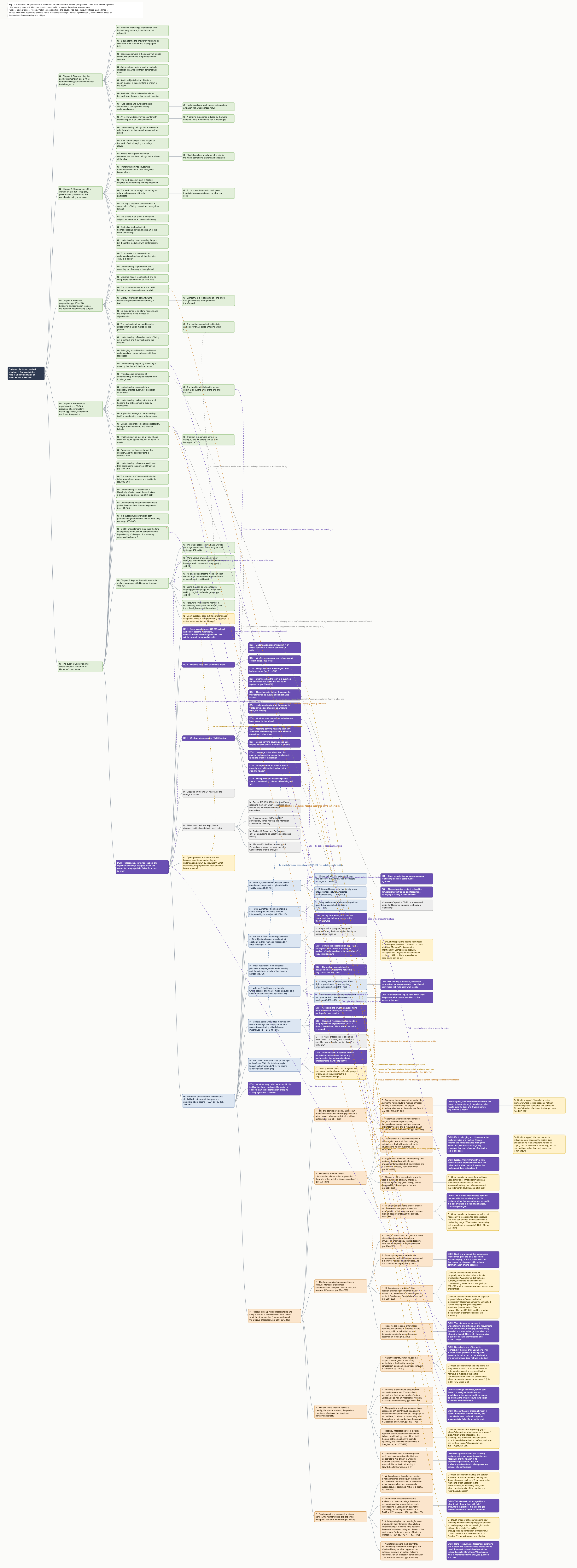
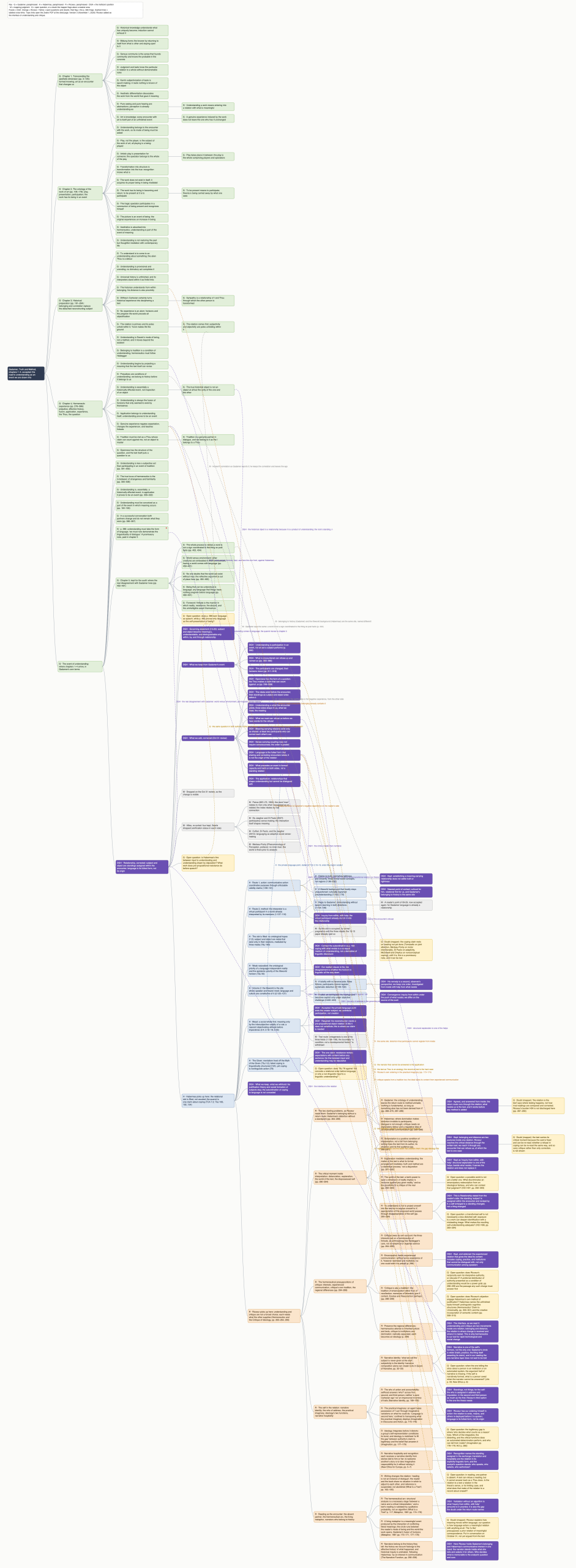
Respond to 01 · Gadamer, chapters 1 to 4