Working notes · A position in progress
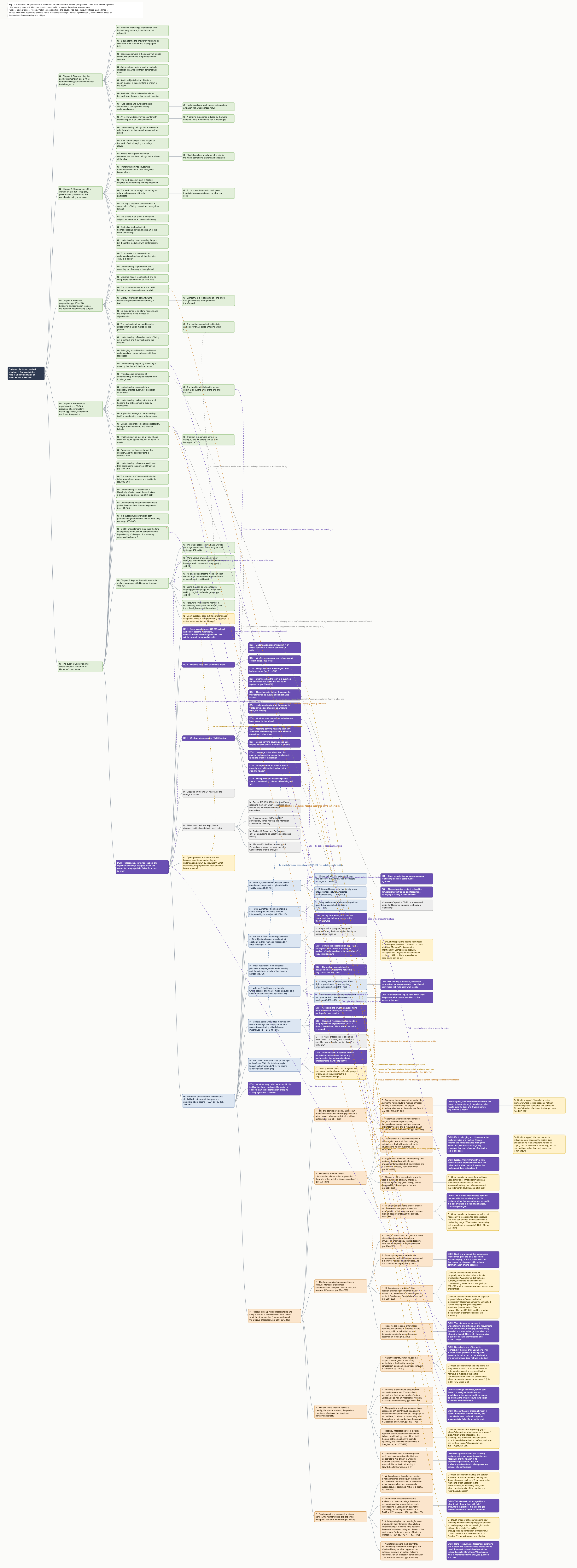
Technological and social change now arrives faster than our ways of knowing can settle it. Hermeneutics moves the question from how we know to how we understand, and the argument that runs from Gadamer through Habermas to Ricoeur locates the interface where understanding meets critique. This map is the institute’s working position on that interface. Questions and critique are invited.
This is a draft of an argument, not a finished one. Every Gadamer, Habermas, and Ricoeur topic carries a note with the paraphrase, the printed pages, and the phrase checked against the text. The purple topics are the institute’s own claims. The yellow topics are open questions, and also the places where we doubt our own weaker areas. Several of them could cost the position its strongest claim. If you see a mistake, a missing text, or a better reading, write to info@dghumana.com.
Why hermeneutics, and why now
The older question, how we can be certain of what we know, does not reach the situation we are in. Machines, records, and institutions now assign us our standing, as patient, applicant, user, or risk, faster than we can contest it. The question that reaches that situation is how understanding happens to us and how it can be corrected. Gadamer makes the move: understanding is an event we are drawn into, not a method we apply. Habermas presses the question the move leaves open: how can understanding be tested when the conditions of agreement are themselves distorted? Ricoeur shows that the two belong together. Interpretation has a critical moment inside it, and critique has an inheritance it cannot do without.
That interface, understanding met by critique, is where we think adjustment to rapid change has to be worked out, and it is why this map exists. Our own claim sits between the three: subject and object are standings assigned within the encounter, meaning-carrying relations exist only as shared, and language is the fullest form of the relation, not its origin. The map shows where that claim is kept, where it is corrected, and where it is still owed an argument.
Key
- GGadamer, paraphrased, with printed page and the phrase checked against the PDF
- HHabermas, paraphrased: Theory of Communicative Action 1 and 2, Truth and Justification
- RRicoeur, paraphrased: Hermeneutics and the Critique of Ideology and seven companion essays
- DGHThe institute’s position: Relationship as standings assigned within the encounter, not things
- MMapping judgment: why a topic sits where it does, and what was dropped
- QOpen question, or a doubt we flag about a weaker area of our own position
- ⚑The hinge: p. 386, understanding must take the form of language
- Labeled cross-link carrying an inferential step across the tree
Open questions
These are the yellow topics on the map. The first group are questions we are putting to the texts and to ourselves. The second group are doubts we hold about our own position; each names what would settle it.
- Does p. 386 of Truth and Method earn language as speech, while p. 490 proves only language as the self-presentation of being?
- Is Habermas’s line between input to understanding and understanding itself drawn by stipulation? What work does pre-propositional resistance do before speech?
- Does Truth and Justification p. 78, read against p. 154, concede a relational order before language, or only a non-linguistic input to a linguistic understanding?
- A possible world is not yet a better one. What discriminates an emancipatory redescription from an ideological fantasy, and who can contest that judgment?
- A transformed self is not necessarily a less distorted self. What makes the resulting self-understanding adequate?
- Does Ricoeur’s reciprocity earn its interpretive authority, or relocate it? A preferred distribution of authority presented as a condition of understanding would be a power grab.
- Does Ricoeur’s objection engage Habermas’s own method of justification, where Habermas names the prelinguistic tasks he left unfinished?
- When the one telling the story about a person is an institution or an automated system, the argument half of narrative is missing. What is a person owed when the narrator cannot be answered?
- The legitimacy gap is where “who decides what counts as a reason” lives. Which of ideology’s functions does an automated determination perform, and who can tell from inside?
- In reading, one partner is absent. Is the relation to a text a relation in our sense, or its limiting case, and what does that make of the relation to a record about oneself?
- Doubt. The coping claim against Habermas rests on reading not yet done. Until it is, it is a promissory note, and it can be lost.
- Doubt. “The relation is the test” says where testing happens, not how rival readings are compared and corrected. Ricoeur’s burden is not discharged.
- Doubt. A text carries its critical moment because the said is fixed and can be re-read. Whether a refusal in coping can be re-read the same way is not shown.
- Doubt. Our objection to Ricoeur on metaphor, that the “is like” presupposes a prior relation of meaning, was put in conversation and is not yet argued from the text.
What changed in version 3
Ricoeur is added as the sixth stage, picked up after Habermas as the interface of understanding and critique. Hermeneutics and the Critique of Ideology carries the stage; Life in Quest of Narrative, Narrative Identity, What Is a Text?, Metaphor and the Central Problem of Hermeneutics, Imagination in Discourse and Action, The Narrative Function, and Reflections on a New Ethos for Europe supply the docking points. The position is now stated as the institute’s, in the plural. The questions are open questions, addressed to any reader, and yellow also marks the places where we doubt our own weaker areas. One such doubt is added under the coping claim. The Gadamer, Event, Relationship, and Habermas stages are version 2’s, with the voice changed.
How the map is built
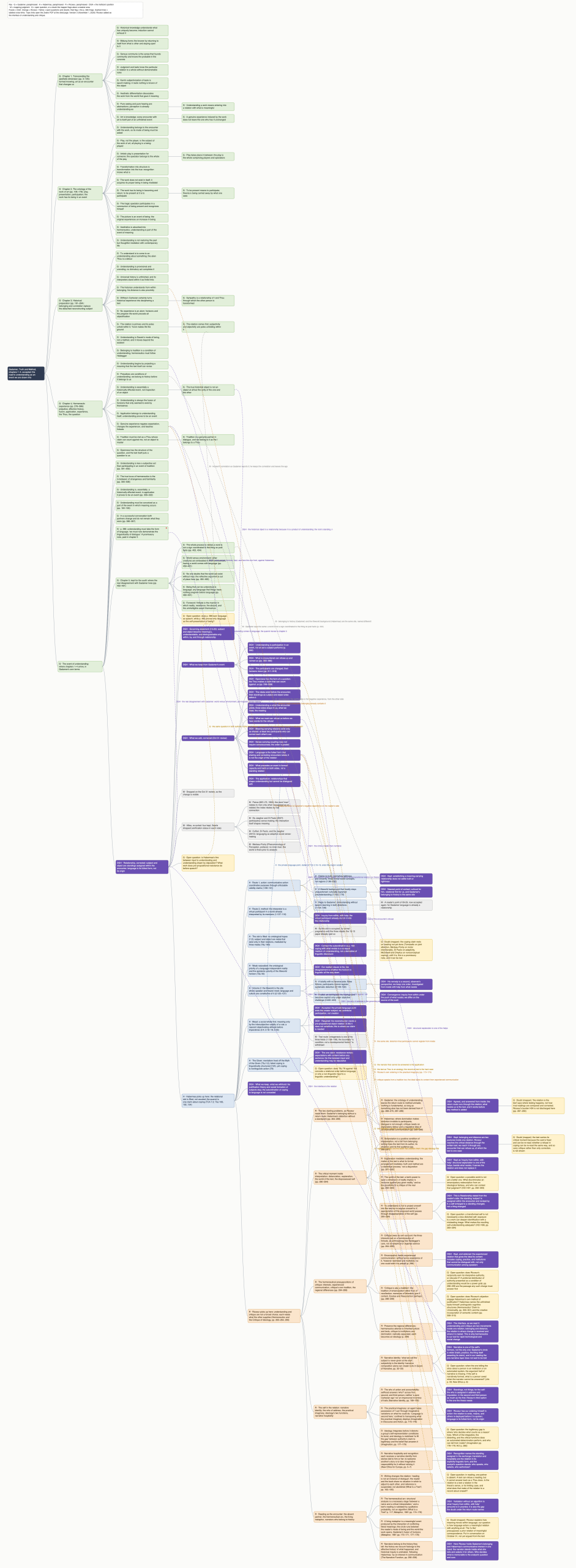
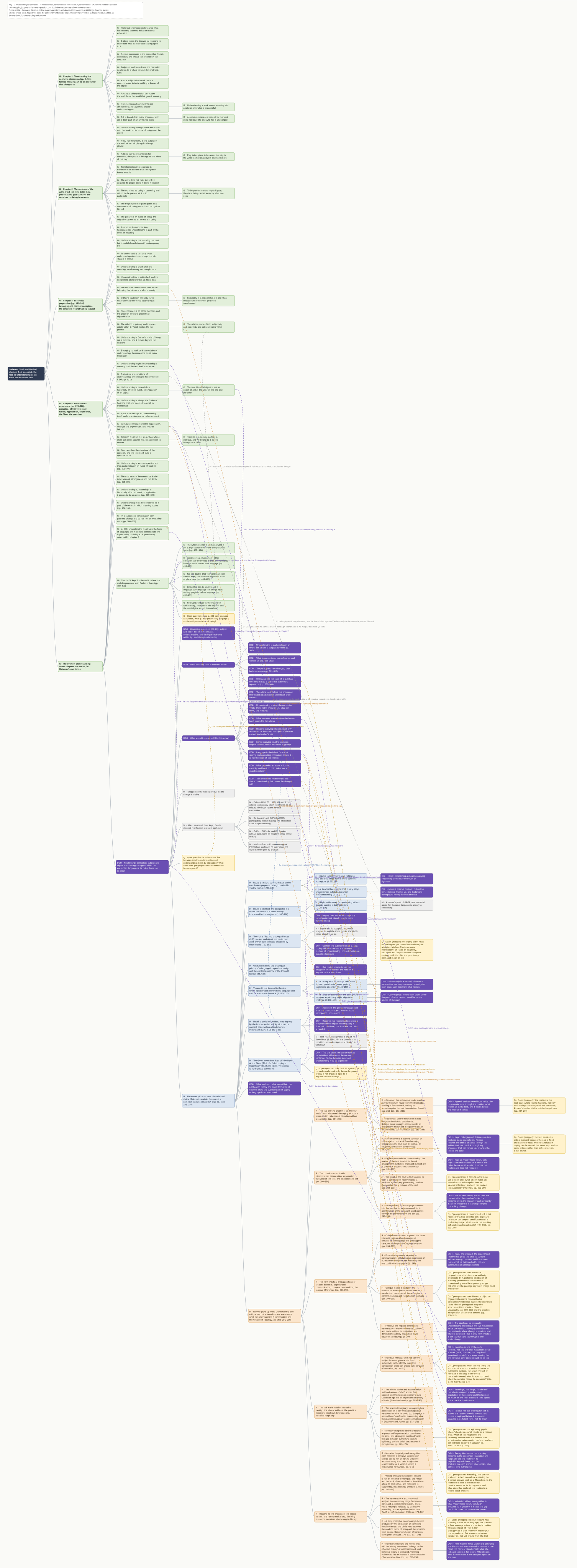
- Root, at the left. Gadamer, chapters 1 to 4, accepted. Each chapter is a route of six to nine stations in the chapter’s own order.
- The event of understanding. Five of Gadamer’s own summative statements, then the hinge at p. 386, then the chapter 5 audit, where the real disagreement with Gadamer lives.
- Relationship. The governing statement, what we keep from Gadamer’s event, what we add, the allies with their verification status, and what we dropped on review so the change stays visible.
- Habermas picks up. The relational slot is filled, not vacated; the quarrel shrinks to one claim about coping. Purple overlay sits where his text needs or admits a pre-propositional relation.
- Ricoeur picks up. The two starting problems as he reads them; the critical moment inside interpretation; the hermeneutical presuppositions of critique; the self in the relation; reading as the encounter. Purple overlay sits where his text states the relation from the reader’s side.
- Cross-links. Twenty-six dashed links carry the argument across the tree: where the position leaves Gadamer, where Ricoeur’s distanciation meets belonging, where critique speaks from a tradition, where the narrator that cannot be answered meets the application.
Outline
Text version of the map (excerpt; the full outline has 162 topics with notes)
- GGadamer, Truth and Method, chapters 1 to 4, accepted: the road to understanding as an event we are drawn into
- GChapters 1 to 4 pp. 3–386
- GThe event of understanding: where chapters 1 to 4 arrive
- Gp. 386: understanding must take the form of language hinge
- GChapter 5, kept for the audit pp. 402–491
- DGHRelationship: subject and object are standings assigned within the encounter
- DGHGoverning statement; what we keep from Gadamer’s event; what we add
- MAllies, re-sorted: Peirce, De Jaegher and Di Paolo, Merleau-Ponty
- HHabermas picks up here: the relational slot is filled, not vacated TCA 1:2, T&J 183
- QDoubt: the coping claim rests on reading not yet done
- RRicoeur picks up here: understanding and critique are not a forced choice HCI pp. 263–264, 299
- RThe two starting problems, as Ricoeur reads them pp. 264–289
- RThe critical moment inside interpretation: distanciation, explanation, the world of the text, the dispossessed self pp. 290–294
- RThe hermeneutical presuppositions of critique: interests, experienced communication, critique’s own tradition pp. 294–299
- DGHThe interface, as we read it: understanding and critique are two movements inside one relation
- RThe self in the relation: narrative identity, the who of address, the practical imaginary, narrative hospitality
- QWhat is a person owed when the narrator cannot be answered?
- RReading as the encounter: the absent partner, the hermeneutical arc, the living metaphor, narrators who belong to history